Vampires are an
incredibly diverse lot. Each one has its own quirks and characteristics that
make it unique, and therefore some are more formidable than others. And while
many vampires in world folklore have unnatural strength and supernatural
powers, one creature stands above them all: the Romanian Vârcolac. Also
known as the Vircolac, this wolf-demon appears in the folklore and tales
all across Romania. The Vârcolac (plural Vârcolaci) is a type of
revenant that comes into existence when a baby dies without having been
baptized previously. Others say that it is a type of werewolf, a ghost, or some
manner of wolf-demon. A person who commits the sin of suicide is very likely to
arise from the grave as this type of vampire. This condition, much like
lycanthropy, can in some cases be hereditary and is passed down in a family
from one generation to the next. A child born out of wedlock, being
"cursed" by God, may also become a Vârcolac upon his or her death.
Sweeping dust out of the house in the direction of the sun at sunset may cause
this creature to arise. More bizarrely, it may also rise up when one is making
maize porridge if one makes the mistake of putting the stick used to stir the
porridge in the fire. Whether one or the other, the Vârcolac is an insanely
powerful beast of a creature that takes delight in the kill, drinking fresh
blood and tearing its victims into unrecognizable pieces.
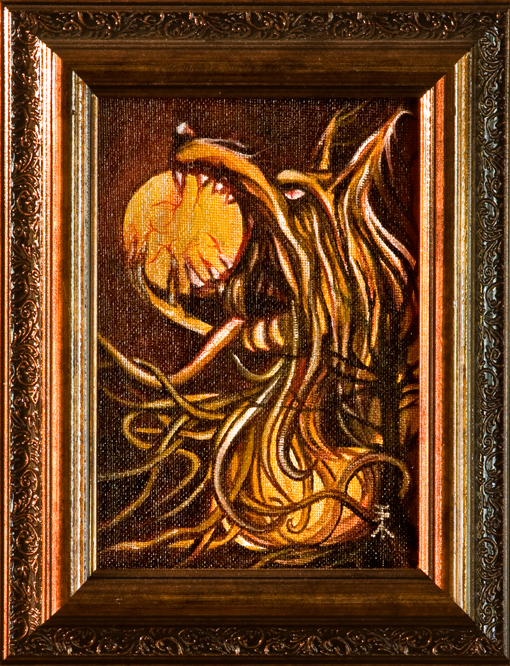
By day, the Vârcolac appears to be human and behaves as an ordinary person would. In human form, the creature has pale, dry skin, dark hair, and fierce, deep-set eyes (whether these eyes are any specific color or have a tendency to glow in the dark is unknown). Like most vampires, the Vârcolac is a nocturnal hunter and generally feeds by night. However, the creature chooses to hunt in its astral form, which is invisible to the human eyes. In this form, the vampire prefers to use deception and speed to a reckless attack with its formidable strength. Traveling in its astral body (which, when actually seen, is described as resembling a dragon or a monster with many mouths), the Vârcolac can move as fast as the wind along unseen astral threads (which is known as "midnight spinning," where a woman spins threads without a candle and sometimes cast spells as they weave) and it is said that the creature is so powerful that it can force the sun and the moon out of alignment, causing an eclipse (either of a lunar or solar nature). As long as those threads remain unbroken, the creature’s power persists and it may travel anywhere it wishes to. However, causing a solar or lunar eclipse would involve forcefully realigning the planets as well as the sun and the moon. If such folklore is to be truly believed, it would suggest that the Vârcolac is a monster of truly immense power. However, since none but God Himself is able to do such a thing, one might be tempted to file that under the category of “superstition”. According to legend, the Vârcolac does this in order to feed on the moon's blood or to eat the moon itself. According to tradition, during an eclipse the people will beat on shovels, pots, pans and other tools, fire off guns, and ring church bells to scare the Vârcolac away. Usually, the moon defeats the creature with its superior strength. If the moon were to truly be eaten, the world would come to a swift end. One folk belief holds that God orders the Vârcolac to consume the moon, so that His people will repent of their sins.
What makes the Vârcolac so dangerous? Some of the sources consulted for the research into this creature say that it is stronger than any other vampire species in folklore, even compared to creatures like the Nelapsi of the Czech Republic and Slovakia or the Alp of German folklore (both of which have been featured on this blog). Needless to say, the Vârcolac possesses an insane degree of strength, and is reportedly able to bash its way through stone and concrete walls with its fists. It is able to hurl the mutilated and broken bodies of its hapless victims into the highest tree branches, where they are unlikely to be found except by those with exceptional observational skills. As well as having supernatural strength, the Vârcolac possesses unnatural speed and agility as well. One thing that this vampire is particularly feared for is its powerful shapeshifting capabilities. The creature is actually said to change its mass as well as its physical form. It may take the form of a small and black, winged ghost, a demon with the legs of a goat and cloven hooves, a small dragon, a dog (it always appears as two dogs), a flea, a cat, a frog, or a spider. The Vârcolac is not, however, limited to these forms. The creature may take any form that it desires, possibly including the form of other people. Using its ability to shapeshift, the Vârcolac is able to lure unsuspecting humans close enough to make its savage attack. Once it strikes, the vampire completely drains its unfortunate prey of their blood.
For all of its power, the Vârcolac does have a handful of weaknesses. If the creature is a living human, it suffers similar vulnerabilities. If the creature's mortal body is moved while they are in the process of astral projection, the astral body will be unable to find its way back to the world of the living and its body. The Vârcolac's human body will either sleep forever or waste away and die. In addition, like most vampires, the Vârcolac has one fatal weakness: garlic. While something so simple may seem laughable, the very presence of this plant (whether the bulb or the flower) weakens the demon considerably. It is supposedly able to force the creature to become flesh and blood again, at which point the creature can be killed like any other physical being. However, people usually resort to the tried-and-true methods of staking, beheading, and burning the creature until naught but ash and charred bones remain.
Despite the fact that the Vârcolac is usually a revenant (the returned dead), there are some ways to destroy the creature. However, it is all highly ritualized and fairly complex. One is to wait until the vampire rises from its grave (although how one is supposed to subdue a creature with superhuman strength, even with a group of strong men, is beyond speculation). The heart should be excised and cut in two. A nail is then driven through the Vârcolac's forehead, and an entire garlic bulb is placed in the mouth. Quicklime may be utilized if garlic is unavailable. The body is then smeared with the fat of a pig killed on Saint Ignatius Day (July 31st). Next, sprinkle the Vârcolac's burial shroud with holy water. Finally, the monster's body should be taken to a secluded place deep in the mountains and left there. Alternatively, if the creature was a woman, iron forks should be driven the corpse's eyes and heart. The body is then buried in a very, very deep grave, face down. However, burning the body and scattering the ashes should always be the go-to solution for any supernatural creature.
Because the Vârcolac is so powerful, there is always a chance that the monster will return. To prevent this from happening, a thorny bush (like hawthorn or the rose bush) should be placed on top of the body, covered by the creature's burial shroud. Those who have committed suicide should be immersed entirely in fresh running water as soon as possible after death. Presumably, this will serve to purify the body and wash away any potential spiritual contamination.
In conclusion, the monsters, ghosts, and spirits of Romanian folklore are both endlessly fascinating and utterly terrifying. This isn’t really surprising, especially when one takes into consideration that Transylvania is a part of the country, and hearing the word itself makes people immediately think of vampires, as well as Bram Stoker’s enigmatic Count Dracula. But there are far older legends lurking in the darkness of those cold, dense forests, and people are still wary of them to this very day. But one chilling question remains: Are the fears and superstitions of the Romanian people justified? Does the Vârcolac still roam the ancient forests at night, seeking new victims to sup on their blood? Many people would say that these beliefs are remnants of the olden days, believing that superstition and folklore have no place in the modern world. What they fail to comprehend is that these beliefs weren't stories made up around a bonfire to scare their children and each other into behaving properly. Their beliefs in the Vârcolac, vampires, werewolves, and the spirits of the unquiet dead came from somewhere, and they have damn good reason for clinging to those beliefs. Their folklore and superstitions are what have helped the Romanian people survive through the ages, so perhaps there's a very good reason for recording and passing on these stories. Does the Vârcolac truly exist? Maybe. That's why it's so important to stay vigilant and be ready for these things whenever they come around.
Sources
Bane, Theresa. Actual Factual Dracula: A Compendium of Vampires. Randleman, NC: NeDeo Press. Copyright ©2007 by Theresa Bane.
Guiley, Rosemary Ellen. The Encyclopedia of Vampires & Werewolves (Second Edition). New York: Checkmark Books. Copyright ©2011, 2005 by Visionary Living, Inc.
Maberry, Jonathan. Vampire Universe. New York: Kensington Publishing Corp. Copyright ©2006 by Jonathan Maberry.
MacDougall, Shane. The Vampire Slayers’ Field Guide to the Undead. Doylestown, Pennsylvania: Strider Nolan Publishing. Copyright ©2003 by Jonathan Maberry.