Monday, February 4, 2013

The Lamia

The Lamia (plural Lamiae) is an ancient Greek demon with the upper body of a gorgeous woman and the lower body of a serpent. Perceived by others as an archaic predecessor of the Vampire, she was originally the Queen of Libya (some say a princess), the daughter of Belus and Libya, and was said to be extremely beautiful. This did not go unnoticed by Zeus, the king of the Greek pantheon. He went to her, seduced her, and made love to her. Eventually, Lamia gave birth to Zeus’s children. Zeus’s wife, Hera, soon found out about her husband’s one-night tryst with the Queen. Notorious for being jealous of Zeus’s sexual escapades, she exacted a grisly revenge on Lamia. Some accounts say that she forced the Queen to devour her own children, while others say that Hera herself killed the children. In some versions of the legend, Hera spared only one child: Scylla, whom she transformed into a vicious six-headed reptilian monster. This act of jealous, wanton cruelty drove Lamia absolutely insane. In a fit of vengeful torment, Lamia swore to take her revenge on children, their mothers, and men alike by slaughtering them and consuming their warm blood. Eventually, the former Queen began to change in shocking ways. Her actions caused her body to twist and warp itself, gradually becoming a blood-drinking monster, half snake and half woman. Other myths say that when Zeus took Lamia as his mistress, he hid her away in a remote cave in Africa. Still, Hera eventually found her and not only murdered her children, but transformed Lamia into her monstrous form. In her embitterment, she formed an alliance with the evil children of Hecate (the goddess of witches and the crossroads), the Empusae. The Empusae are hideous nocturnal hags that take the form of beautiful women to seduce young men. Once an Empusa had her victim, she would suck the lifeforce from him until he died and naught but a withered corpse remained. But regardless of how it happened, Lamia has hated the human race with a passion ever since that fateful day.

The Lamia is a unique species of demon. She has the long tail of a serpent, fingers tipped with wickedly sharp talons, and a mouthful of long, daggerlike teeth. She is a shapeshifter, able to assume the forms of various types of birds, which enables her to soar through the air while hunting for suitable prey. Stories also tell of her being able to take a wholly human form, usually that of a voluptuous and beautiful woman. She has a supernatural degree of strength and speed, and the reptilian scales covering her body make it difficult to wound her. Since she is part snake, it is likely that her bite carries a potent venom (although this is purely speculation). None of the ancient texts relate as to how this demoness may be slain (although decapitation and burning the body are good bets). It is said that, as a gift for her favors, Zeus granted her the ability to remove and replace her own eyes at will (which is said to be symbolic of prophecy, or “second sight”). When she sleeps, Lamia removes her eyes so that she may see any attempt at an ambush or attack and react accordingly. However, she is truly vulnerable in this state. As for a dwelling place, the Lamia favors dark, dank places (like caves). By night, she prowls human settlements in search of her favorite prey: sleeping babies. Once she found them, she would steal them from their cradles and take them back to her lair, where she would drink their blood.

The Lamia’s favored method of attack is to tear out the intestines, consume the flesh, and drain the victim’s blood. If her prey is a woman, she will suck out any milk. To that end, she often seeks out pregnant victims so that she may kill both the mother and her unborn child at the same time. Lamia’s voracious appetite justified her name, which is derived from the Greek word lamyros, which means “gluttonous.” However, women and children aren’t the only ones at risk. The Lamia loves to lure men into a lonely place for a tryst, seduce them, and make love with them. Then, just when her victim reaches orgasm, she tears out his throat and gulps down the spurting blood. She is a sexual predator as well as being a cannibal and a Vampire, and is an extremely dangerous foe. To this day, it is said that children still greatly fear her as a sort of bogeywoman. The Lamia is most definitely not a monster to be trifled with.

Sources

Allan, Tony. The Mythic Bestiary: The Illustrated Guide to the World’s Most Fantastical Creatures. London: Duncan Baird Publishers Ltd. Copyright ©2008 Duncan Baird Publishers and Tony Allan.

Bane, Theresa. Actual Factual Dracula: A Compendium of Vampires. Randleman, NC: NeDeo Press. Copyright ©2007 by Theresa Bane.

Cheung, Theresa. The Element Encyclopedia of Vampires. New York: Metro Books, by arrangement with HarperCollins Publishers. Copyright ©2009 by Theresa Cheung.

Curran, Dr. Bob. Vampires: A Field Guide to the Creatures that Stalk the Night. Franklin Lakes, NJ: The Career Press, Inc. Copyright ©2005 by Dr. Bob Curran.

MacDougall, Shane. The Vampire Slayers’ Field Guide to the Undead. Doylestown, Pennsylvania: Strider Nolan Publishing. Copyright ©2003 by Jonathan Maberry.

Maberry, Jonathan. Vampire Universe. New York: Kensington Publishing Corp. Copyright ©2006 by Jonathan Maberry.


Matthews, John and Caitlin. The Element Encyclopedia of Magical Creatures. New York: Barnes & Noble Inc., by arrangement with HarperCollins Publishers. Copyright ©2005, 2008 by John and Caitlin Matthews.

Wednesday, January 30, 2013

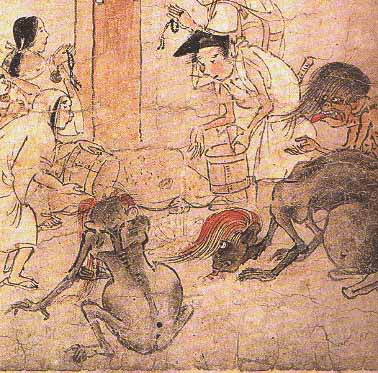
The Gaki

The Gaki is a type of corporeal ghost hailing from Japan, where such spirits are known as yurei. The word gaki itself means "hungry ghost." The Gaki comes into being when a person who was very greedy in life dies or a man who led a sinful life but failed to repent before he passed away. However, the spirit is forced to return to the earthly plane instead of moving on to Heaven or Hell. On the material plane, the Gaki wanders about for eternity, cursed with a hunger for blood that can never be sated.

According to legend, the Gaki is described as having pale skin that is cold to the touch, hollow features, and most significantly, a huge, distended stomach and a narrow neck. In short, the creature bears a striking resemblance to a victim of starvation. This ghost is said to be a shapeshifter, and when attacking, the Gaki takes a humanoid form with red skin, small horns on top of its head, and a long white beard. It also wields a wooden pike as a weapon while in this form.

It should be noted that there are several different species of Gaki, and each one has specific dietary needs. The most dangerous Gaki species feeds only on the flesh, blood, and souls of living humans. Another is said to consume a person's thoughts while they meditate, resulting in the person being irritable and lacking a sense of inner calmness. Others eat samurai topknots, tea, paper, tattoos, sweat, and incense.
 
Where do the Gaki come from? When a person dies, according to Japanese beliefs, he is reborn or reincarnated as a different creature on another world. There are six courses of rebirth: 1) the person is reborn as a man or a woman in this world, 2) they are reborn as an animal on Earth, 3) the person ascends to Heaven (Gokuraku), 4) they descend to Hell (Jigoku), 5) reincarnated as a shura (short for Ashura, the lowest order of deities and demigods) and suffer through endless battles, and finally 6) they face rebirth as a Gaki in the desolate world of Gakido. In this world, they suffer from unending hunger and agonizing thirst. The Gaki will try to devour everything that they possibly can, including their own children. This is the punishment which will befall all those who have wasted precious food.
 
The Gaki is as intelligent as it was in life, and the monster revels in the darkness in which it dwells, and uses the blackness of night to aid in its hunt. This hungry ghost lures its prey in by emitting lonely wails, sounding eerily like an injured child or someone who has become hopelessly lost. Those who intend to help eventually find themselves face to face with an undead monstrosity with wickedly sharp teeth and a hunger born out of the very pits of Hell. Once the Gaki has a hold on its prey, it rips and tears at the victim's flesh. It enjoys this act so much that the revenant will even risk harm to itself. Once the victim is dead, the Gaki feasts on the body, savoring every shred of meat and every last drop of blood. But once the creature has finished feeding, the curse immediately comes to bear: the Gaki finds that it is starving to death once again. No matter how many people this ghoul kills, it will always be in agony from hunger and thirst.

In other tales (in which the creature only hungers for fresh blood), it is said that the Gaki's throat is nearly closed from sheer thirst. As such, the monster is only able to swallow a few drops of blood at a time and thus cannot consume enough to keep it's hunger assuaged. In some similar stories, the Gaki craves ordinary food instead of human flesh and blood. However, even if the monster is surrounded by food, the food turns into blood or hot coals as soon as it touches the Gaki's lips. Because of this, it kills out of anger and sheer frustration in such stories.

Due perhaps to its supernatural nature, the Gaki has unnatural strength and is a very persistent foe. The monster has the ability to shapeshift, often taking the form of a mist, various animals, and even impersonating living people. But while in the latter form, the Gaki's true nature can be discovered with a single touch: the creature's skin is cold and bloodless. But while it is in the form of a mist, the monster cannot be hurt except by weapons forged especially for inflicting harm on ghosts. It is believed that the ghost doesn't have to physically manifest itself to feed, as it is thought that merely being near the creature can drain one's blood away.

Even though it is difficult to even harm the creature, the Gaki does have a handful of vulnerabilities. When it attacks, the ghost goes into a kind of maddened frenzy, during which it fixates on its prey and moves about in a seemingly random manner. While in this state, the Gaki leaves itself open to attacks. It also talks to itself incomprehensibly, which can prove to be distracting to the hunter. But because of the difficulty in destroying this creature, it is perhaps best to drive it off. Rituals and prayers performed Shinto priests or Buddhist monks may accomplish this. Stamping scrolls with the Buddha's image and placing them around one's home will prevent the Gaki from entering. One may prevent an attack by following the example of zen monasteries: making a small offering of food to the ghost before eating one's own meal.

As for actually destroying the Gaki? Some sources say that it is possible to do so, but it is not an easy task. As mentioned earlier, a weapon made especially for harming ghosts (perhaps a sword or some kind of edged weapon) may be used against the monster. However, this must be done while the Gaki is in a state of physical manifestation, as it cannot be completely destroyed while in it's incorporeal state. And again, as mentioned previously, it may be attacked while in a frenzied condition. While it will be difficult to strike the Gaki and defend oneself from the monster's own attacks, the Gaki will make no attempt to defend itself. Once the creature has been dealt with, the body must be burned to ashes and scattered to the four winds.

Sightings or reports of the Gaki are something of a rarity today, possibly due to modern burial practices (like cremation) and traditional Japanese funerary rituals. However, that doesn't mean that these hungry ghosts aren't still out there in the darkness, waiting for it's next meal...

Sources

 
Bane, Theresa. Actual Factual Dracula: A Compendium of Vampires. Randleman, NC: NeDeo Press. Copyright ©2007 by Theresa Bane.

Maberry, Jonathan. The Vampire Slayers’ Field Guide to the Undead. Doylestown, Pennsylvania: Strider Nolan Publishing. Copyright ©2003 by Jonathan Maberry.

Maberry, Jonathan. Vampire Universe. New York: Kensington Publishing Corp. Copyright ©2006 by Jonathan Maberry.


Saturday, January 5, 2013

The Yara-Ma-Yha-Who


Among the Aborigines of Australia are tales of many strange and dangerous creatures. Australia has always been home to strange creatures, such as the platypus, the kangaroo, the cassowary, and many others. But perhaps the strangest of all is the Yara-Ma-Yha-Who, a short, red-skinned demon with a vampirelike thirst for human blood. It is described as being a small red man, approximately four feet in height, with very large head and an enormous, gaping mouth (which is toothless). The creature appears to be bipedal (although crawling about on all fours like a lizard is not unheard of), but the monster’s toes and fingers are tipped with toothed suckers (like those of an octopus or a squid), which it may use for clinging onto trees or for holding onto its victims. However, the primary purpose of these suckers is to drain the blood of the Yara-Ma-Yha-Who’s unfortunate victim.

This monster dwells in large, leafy trees, particularly fig trees (although some sources say that the creature lives in caves near a water source). But unlike other monsters, the Yara-Ma-Yha-Who does not actively hunt for its prey. Instead, it waits for food to come to it. When a weary traveler pauses to rest under its tree, the Yara-Ma-Yha-Who makes its move. It drops itself on its victim, surprising them and ensuring that the struggle is brief. While the Yara-Ma-Yha-Who may be diminutive, the creature possesses supernatural strength that makes tackling fully-grown men easy. Using the toothed suckers on its fingers and toes, the monster then proceeds to drain the victim’s blood. Like the Vampire of Central and Eastern Europe, the Yara-Ma-Yha-Who rarely kills its victim outright. It leaves just enough blood in the victim that they are still alive, but too weak to make an escape. The creature then goes off on a walk in an effort to burn off some of the blood it has consumed (like people may do after a large meal) in order to regain its appetite. Eventually, the creature returns to its victim.
 
Once the Yara-Ma-Yha-Who has returned, it lies down on the ground while facing the victim. It then proceeds to crawl over to its prey in the manner of a lizard, and swallows the victim whole. The creature then stands up and dances about, attempting to move the still-living body of its victim down into its stomach. After some time has passed, the monster drinks some water and vomits the unfortunate person back up. The victim, however, is still completely intact and alive However, because the Yara-Ma-Yha-Who only hunts during the day, the creature must seek a bush in which to sleep for the night. The victim, if they’re still alive, can then try to escape. Even if the monster awakens and goes after them, the creature’s prey still has a good chance of getting away, as the Yara-Ma-Yha-Who has a slow, wobbling gait on the ground. But if the unlucky human doesn’t escape, he is swallowed whole a second time. Then, once again, the creature throws the victim up. However, the victim is now shorter than before and has a reddish tinge to his skin. If the victim is still unable to escape, he is swallowed and regurgitated a third time. Now, he is not only almost the Yara-Ma-Yha-Who’s height, but his skin is smooth and hairless as well (conversely, in some stories it is noted that the victim’s body grows an excessive amount of hair during its transformation). If this disgusting process is repeated enough times, the victim himself will eventually become a Yara-Ma-Yha-Who.
 
In other stories, it is said that the monster only swallows its victim twice. It will, however, return to savor that particular victim’s taste again and again until they become a monster themselves. It is said that if the Yara-Ma-Yha-Who fails to release its prey, the spirit of the fig tree it hides in will enter the creature’s body through an ear, and the spirit makes a sound so loud that it causes the monster’s own spirit to flee its body, which is transformed into a form of tree fungus. Other than that, there seems to be no way to kill the Yara-Ma-Yha-Who. Within the Aboriginal tribes, children are told by their parents that if they are ever attacked by the creature, they should not struggle or offer any resistance. This way, their chances of surviving the encounter are much greater.
 
Sources

Bane, Theresa. Actual Factual Dracula: A Compendium of Vampires. Randleman, NC: NeDeo Press. Copyright ©2007 by Theresa Bane.

Maberry, Jonathan. The Vampire Slayers’ Field Guide to the Undead. Doylestown, Pennsylvania: Strider Nolan Publishing. Copyright ©2003 by Jonathan Maberry.

Yara-Ma-Yha-Who (Monstropedia)

Friday, January 4, 2013

Recent Amazon Purchases

For Christmas, I received over $225 worth of Amazon giftcards (well, I used cash that I had received to get another $30 set of giftcards). With it, I bought a total of seventeen books. Most of them have came, but four that I ordered were used or out of print. Two of those I won't get until the end of January to the middle of February, and I should have the other two within a couple of weeks (I hope). Here is a list of what I ordered, starting with what I've received thus far.

Haunted Indiana: Ghosts and Strange Phenomena of the Hoosier State (James A. Willis)
Monster Diary: On the Road in Search of Strange and Sinister Creatures (Nick Redfern)
Wildman! The Monstrous and Mysterious Saga of the "British Bigfoot" (Nick Redfern)
The Beginner's Guide to the Long Sword: European Martial Arts Weaponry Techniques (Steaphen Fick)
Food for the Dead: On the Trail of New England's Vampires (Second Edition, Michael E. Bell)
Mexican Bestiary: Bestiario Mexicano (David Bowles and Noe Vela)
Shock! The Black Dog of Bungay (David Waldron and Christopher Reeve)
The Banshee (Elliot O'Donnell)
Spirits, Fairies, Leprechauns, and Goblins: An Encyclopedia (Carol Rose)
The Haunting of America: Ghosts & Legends of America's Haunted Past (Troy Taylor)
Not of This World: Creatures of the Supernatural in Scotland (Maurice Fleming)
Ghosts: An Exploration of the Spirit World, from Apparitions to Haunted Places (Paul Roland)
Medieval Swordsmanship: Illustrated Methods and Techniques (John Clements)

And here are the items that are on their way, but I haven't received yet.

The Element Encyclopedia of Vampires: An A-Z of the Undead (Theresa Cheung)
The Big Grey Man of Ben MacDhui (Affleck Grey)
A Dictionary of Vampires (Peter Haining)
Chambers Ghosts and Spirits

I am happy to announce that I have received all four of these titles. And there you have it, folks. Most of these books are about or related to monsters, cryptozoology, the Undead, Vampires, ghosts, etc. I have been wanting most (if not all) of these for a very long time. I hope that I've inspired you to consider investing your money in Amazon. You won't regret it, I promise you.

Tuesday, January 1, 2013

Redcap

The Redcap is a type of evil, murderous goblin or faery found along the border between England and Scotland. Also known as a powrie, dunter, fir larrig, or bloodycap, this creature is said to look like a short, muscular man with glowing red eyes, fingers tipped with talons sharper than an eagle's, and a mouthful of large, pointed teeth. Despite its size, the Redcap has unnatural strength and can easily overpower a grown man. It wears iron-shod boots and carries a heavy pikestaff or a scythe, neither of which slow the creature down at all. The Redcap is said to move very quickly, and outrunning one of these monsters is said to be impossible. Legend says that the Redcap constantly makes a very distinctive sound, like flax being beaten. When this sound becomes especially loud, it is viewed by local people as being a portent of death or misfortune to come.

The Redcap is known to move from place to place at a moment's notice, but can most often be found inhabiting ruined castles, waiting for potential victims to pass by. Those who trespass into their homes are slaughtered by being pushed off of the castle ramparts, having boulders rolled onto them from the top of a cliff, or are just savagely murdered with the goblin's own claws and teeth (or its pikestaff). Once the unfortunate victim is dead, the Redcap then dips its cap into the flowing blood, dyeing it red (which is where this creature gets its name). If the blood ever dries out, the Redcap will die. Therefore, it must kill regularly in order to survive. The only way that one may escape from the Redcap is to recite a passage from the Holy Bible, which causes the faery intense pain and will force it to flee. Brandishing a crucifix at the creature will also cause it intense pain and make it run away. It may also be warded off or even harmed by cold-forged iron (a weakness shared by most faery species).

Sources

Redcap (Monstropedia)

Redcap (Wikipedia)

Friday, December 28, 2012

Camazotz (The Death Bat)

Also known as the Death Bat and Sudden Bloodletter, Camazotz was the bat god of the ancient Mayan people. This vampiric winged demon was the god of darkness, violence, and sacrifice (especially blood sacrifice). The name Camazotz itself is derived from two words in the K'iche' language: kame, which means "death," and sotz', meaning "bat." Camazotz was said to inhabit Xibalba, the Mayan version of Hell. This nightmarish creature reveled in the slaughter of innocent people, and was said to be especially fond of drinking human blood. Those who devoted themselves to this deity would open a vein, fill a wooden or ceramic bowl with their blood, and would offer it up to the Death Bat. He is depicted as being a sacred vampire.

Originally, Camazotz was an anthropomorphic bat-monster worshipped by the Zapotec Indians of Oaxaca, and was later adopted by the Mayans as a vampire god that demanded offerings of blood from it's followers in exchange for the deity's favors or aid. The cult of Camazotz itself began sometime around 100 B.C. Camazotz is featured prominently in the Popul Vuh, a compendium of Mayan mythology and beliefs. In Xibalba, the demon presides over a house of gigantic bat-creatures like himself in Zotzilaha (in what is now Guatemala), the only difference being that they acknowledge the Death Bat as their lord and master.

One legend tells of the Mayan Hero Twins Hunahpu and Xbalanque encountering Camazotz and his kin during their trials in the underworld. The twins had to squeeze themselves into their own blowguns to protect themselves from the circling bats. Hunahpu made the mistake of sticking his head out to see if the sun had risen. Camazotz himself immediately snatched his head off and flew up to the ballcourt, where the head would be used as the ball by the gods in their next ballgame. Xbalanque then calls upon every animal in the forest to bring him their favorite foods. One of these animals brings him a squash, from which Xbalanque carves his brother a new head. The brothers continue on through Xibalba, finally finding and defeating Camazotz (as well as other lords of the underworld), banishing him from creation.

It is thought by some that the legend of Camazotz may in fact be derived from the prehistoric vampire bat, Desmodus Draculae, or the Giant Vampire Bat. This bat is twenty-five percent larger than the common vampire bat (Desmodus Rotundus), and fossilized remains have been found that date back as recently as ten thousand years ago. Some think that D. Draculae may still be around today, and was apparently still common around the time of the Mayans. But is there something else to the legend, perhaps something supernatural? Possibly. They may never know for sure.

Sources

http://en.m.wikipedia.org/wiki/Camazotz#section_1

http://www.blueroadrunner.com/camazotz.htm

http://ferrebeekeeper.wordpress.com/2011/04/06/camazotz-the-death-bat/

Camazotz, Mayan God of Bats

Tuesday, December 18, 2012

AM FEAR LIATH MÒR - THE BIG GREY MAN OF SCOTLAND'S BEN MACDHUI


Researched, Compiled, Edited and Illustrated

By "The Cryptozoologist" (R. Merrill)
Ben Macdhui is the second highest peak in Scotland, a huge mountain with deep corries, situated in the Cairngorms: one of Scotland's finest mountain ranges, and a magnet for walkers, climbers and other outdoor enthusiasts. Ben Machdhui is also reputed to be haunted by 'something' that is popularly known as the The "Big Grey Man" (a literal translation of his Scottish Gaelic name "Am Fear Liath Mòr").

Strange experiences have been recorded on the mountain from at least the turn of the twentieth century. Various witness sightings and experiences have amalgamated into a popular image of a huge ape-like misty figure that has the malign power to send people into a blind panic. In an attempt—as some writers have speculated—to push them over the steep cliffs of Lurcher's crag.

Witness Experiences on Ben MacDhui

Professor J. Norman Collie was a highly respected scientist and mountaineer. In 1896 he was appointed Professor of Organic Chemistry at University College London and amongst his other achievements he was responsible for the first ever medical X-ray photograph. He was also a Fellow of the Royal Society. In the climbing world he pioneered many climbs on the Isle of Skye and in the Alps, and, in 1895, he was part of the first ever attempt on a 26,247 ft (8000m) peak in the Himalayas, Nanga Parbat. He later went on to make 21 first ascents in the Canadian Rockies. He is remembered in the names of Mount Collie in Canada and Sgurr Thormaid ("Norman's Peak") on Skye.

So when, in late 1925, the still eminent and active Professor Collie stood up to give a speech to the 27th Annual General Meeting of the Cairngorm Club in Aberdeen, he was a man whose words carried a great deal of weight with his audience. Which added all the more to the impact of part of what he had to say, about an experience he had while alone on the summit of Ben MacDhui in the Cairngorms, 34 years earlier in 1891:


"I was returning from the cairn on the summit in a mist when I began to think I heard something else than merely the noise of my own footsteps. For every few steps I took I heard a crunch, and then another crunch as if someone was walking after me but taking steps three or four times the length of my own. I said to myself, "This is all nonsense". I listened and heard it again, but could see nothing in the mist. As I walked on and the eerie crunch, crunch, sounded behind me, I was seized with terror and took to my heels, staggering blindly among the boulders for four or five miles nearly down to Rothiemurchus Forest. Whatever you make of it, I do not know, but there is something very queer about the top of Ben MacDhui and I will not go back there again by myself I know."

Professor Collie's comments caused a sensation and attracted a great deal of press coverage. Suddenly other respectable and responsible climbers and hillwalkers started to acknowledge that they, too, had similar experiences on Ben MacDhui but had not broadcast them before for fear of ridicule.

Alastair Borthwick's superb 1939 book about climbing in Scotland, Always a Little Further relates the accounts of two climbers he knew who had experienced what by then was becoming known as Am Fear Liath Mòr, Ferlas Mor, or the Big Grey Man of Ben MacDhui, because of its appearance when briefly glimpsed by a few of those who encountered it.

The first was alone, heading over MacDhui for Corrour on a night when the snow had a hard, crisp crust through which his boots broke at every step. He reached the summit and it was while he was descending the slopes which fall towards the Larig that he heard footsteps behind him, footsteps not in the rhythm of his own, but occurring only once for every three steps he took.


"I felt a queer crinkly feeling in the back of my neck," he said, "but I said to myself, 'This is silly, there must be a reason for it.' So I stopped, and the footsteps stopped, and I sat down and tried to reason it out. I could see nothing. There was a moon about somewhere, but the mist was fairly thick. The only thing I could make of it was that when my boots broke through the snow-crust they made some sort of echo. But then every step should have echoed, and not just this regular one-in-three. I was scared stiff. I got up, and walked on, trying hard not to look behind me. I got down all right—the footsteps stopped a thousand feet above the Larig—and I didn't run. But if anything had so much as said 'Boo!' behind me, I'd have been down to Corrour like a streak of lightning!"

The second man's experience was roughly similar. He was on MacDhui, and alone. He heard footsteps. He was climbing in daylight, in summer; but so dense was the mist that he was working by compass, and visibility was almost as poor as it would have been at night. The footsteps he heard were made by something or someone trudging up the fine screes which decorate the upper parts of the mountain, a thing not extraordinary in itself, though the steps were only a few yards behind him, but exceedingly odd when the mist suddenly cleared and he could see no living thing on the mountain, at that point devoid of cover of any kind.

"Did the steps follow yours exactly?" I asked him. "No," he said. "That was the funny thing. They didn't. They were regular all right; but the queer thing was that they seemed to come once for every two and a half steps I took." He thought it queerer still when I told him the other man's story. You see, he was long-legged and six feet tall, and the first man was only five-feet-seven.

Once I was out with a search-party on MacDhui; and on the way down after an unsuccessful day I asked some of the gamekeepers and stalkers who were with us what they thought of it all. They worked on MacDhui, so they should know. Had they seen Ferlas Mor? Did he exist, or was it just a silly story? They looked at me for a few seconds, and then one said: "We do not talk about that."

These were the first recorded encounters of the Grey Man and caused something of a sensation at the time, creating a lot of interest in the mountain and its possible other-world denizen. It is interesting to note that Cameron McNeish, the respected outdoor author and walker, has noted that Norman Collie was a well known practical joker. He would certainly have been amused by all the publicity that was generated by the story.

A second hand account exists that the mountaineer Henry Kellas, and his brother witnessed a giant figure on the mountain around the turn of the 20th Century, which caused them to flee down Corrie Etchachan. This has never been verified as Henry Kellas died on the Everest reconnaissance mission of 1921, before Norman Collie's speech to the Cairngorm Club.

In 1945 a climber named Peter Densham reported hearing footsteps and fleeing the mountain in panic. Peter was part of the team that was responsible for aeroplane rescue in the Cairngorms during the war.

Another experience on the mountain by Alexander Tewnion—Naturalist and Mountaineer—appeared in The Scots Magazine, in June 1958. It took place in 1943 when he was climbing Ben Macdhui armed with a loaded revolver in search of game for the pot (perhaps naturalist was stretching it a bit). He was returning from the mountain by the Corrie Etchachnan track in fear of getting caught in a storm, here is his account of the event:


"I am not unduly imaginative, but my thought flew instantly to the well-known story of professor Collie and the Fear Liath Mhor. Then I felt the reassuring weight of the loaded revolver in my pocket. Grasping the butt, I peered about in the mist here rent and tattered by the eddies of wind. A strange shape loomed up, receded, came charging at me! Without hesitation I whipped out the revolver and fired three times at the figure. When it still came on I turned and hared down the path, reaching Glen Derry in a time that I have never bettered. You may ask was it really the Fear Laith Mhor? Frankly I think it was. Many times since then I have traversed MacDhui in the mist, bivouacked out in the open, camped on its summit for days on end on different occasions—often alone, and always with an easy mind. For on that day I am convinced I shot the only Fear Liath Mhor my imagination will ever see."

Fortunately for Alexander the figure that he filled with lead was intangible and not a lost tourist, this account does show that by 1958 the Fear Liath Mhor had become part of the popular culture of the mountain.

Another witness encounter involved a friend of the author Richard Frere, who wished to remain anonymous. He was camping on top of the mountain when he saw a large brown creature swaggering away down the mountainside in the moonlight. He estimated the size of the figure at around twenty feet tall. Author Wendy Wood heard footsteps following her in the vicinity of the mountain, after hearing Gaelic music, and there have been other reports of phenomena on the mountain, from ghostly music, feelings of panic to the discovery of huge footprints in the 1940's.

Reports are not wholly confined to Ben MacDhui either. One day during the early 1920s, while coming down alone from Braeraich in Glen Eanaich. which is close to Ben MacDhui. experienced mountaineer Tom Crowley heard footsteps behind him. When he looked around, he was horrified to see a huge grey mist shrouded figure with pointed ears, long legs and finger-like talons on its feet. He did not stay for a closer look.


Wales's answer to the Big Grey Man is the Grey King, also known as the Brenin Llwyd or Monarch of the Mist. Said to frequent Snowdon. Cader Idris Plynlimon and other lofty peaks, this awesome entity was greatly feared in times past as a child-stealer, and even the mountainguides were nervous of venturing into its domain.

Description

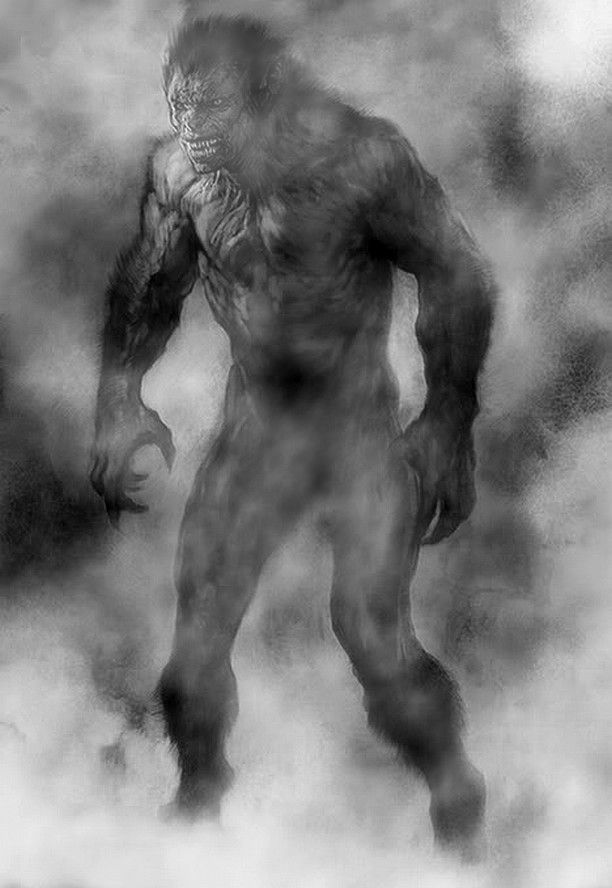
In appearance, the Big Gray Man most often resembles an enormous human, between ten and twenty feet tall, covered all over with a thick layer of hair or fur. He is usually described as gray, sometimes as brown. The head and neck are disproportionately large in comparison to the rest of the body. The ears are pointed. The toes are very long, more like fingers than toes, and end in large, sharp talons. The Big Gray Man has long legs, but the arms are not longer in proportion to the rest of his body than they would be on a human being. In overall appearance, he is described as far closer to man than ape. The Big Gray Man walks very erect, not stooped over or humped like some hairy humanoids. In some sightings, he wears a top hat. He is often partially shrouded by mist or fog, which seems to come with him and retreat when he retreats.

Sightings have been reported since at least the 1700s, and continue to the present day. A number of famous mountain climbers have sworn that the Big Gray Man is real because of personal encounters. Footprints have been photographed, but these are abnormal even for a Bigfoot-type creature. The 19-inch prints are nearly as wide as they are long.

It should be noted that spelling variations between American and British versions of English sometimes make it hard to look up information about the Big Gray Man. Most American authors write "Big Gray Man" while European authors write "Big Grey Man" ("gray" is spelled with an "e" in Britain).

Explanations?

There have been many explanations for the Grey Man phenomena, but looking at the experiences as a whole there are actually very few sightings of a 'Grey Man'. Most accounts are associated with feeling rather than actual physical sightings, and even those that are sightings do not agree: A huge grey mist-like figure, a great brown creature 20 feet tall, and a dark human shaped figure.

Some people have put forward the theory that a wild-man or yeti type creature inhabits the area. I think we can safely dismiss this, I have met some wild men from the area, but they were much less hairy than the average yeti and more inclined to be propping up a bar in the wee hours than roaming the cairngorm plateaux scaring the wits out of hapless tourists. Besides explaining a mystery with another mystery is never a good option.

A more reasonable explanation for some of the sightings of huge figures in the mist could be phenomena known as the Brocken spectre, named after the German mountains where the effect was first discovered. An early account of such an event occurs in In the Shadow of Cairngorm by The Rev. W. Forsyth,

'Sir Thomas Dick Lauder describes such an appearance (Edinburgh New Philosophic Journal, 1831.)


“On descending from the top (of Ben Mac Dhui) at about half-past three P.M., an interesting optical appearance presented itself to our view. We had turned towards the east, and the sun shone on our backs, when we saw a very bright rainbow described on the mist before us. The bow, of beautifully distinct prismatic colours, formed about two-thirds of a circle, the extremities of which appeared to rest on the lower portion of the mountain. In the centre of this incomplete circle there was described a luminous disc, surrounded by the prismatic colours displayed in concentric rings. On the disc itself, each of the party (three in number), as they stood about fifty yards apart, saw his own figure most distinctly delineated, although those of the other two were invisible to him. The representation appeared of the natural size, and the outline of the whole person of the spectator was most correctly portrayed. To prove that the shadow seen by each individual was that of himself, we resorted to various gestures, such as waving our hats, flapping our plaids, etc., all which motions were exactly followed by the airy figure.”

This account shows that the Brocken effect, where shadows are reflected onto mist banks giving the appearance of huge figures, has occurred on Ben Machdhui.

An interesting explanation for the sound of following footsteps was put forward some years ago, and appeared in the popular Trail magazine. It was suggested that the sound could be caused by freezing action upon footprints recently created in snow. We would first have to presume that the encounter in 1891, and other witness testimonies of footsteps, took place in the appropriate conditions.

The most common factor that links the experiences on the mountain is the feeling of blind panic that the witnesses feel. Some researchers have named such experiences 'Mountain Panic' which is basically a blind panic in wild places. Either as a feeling of a powerful presence, or just an overwhelming sense of fear about nature or something that lies behind nature. This kind of encounter is not uncommon: Chris Townsend the respected long distance walker and author mentions such an experience in 'The Munro's and the Tops'. In Glen Strathfarrar on a track by the Allt Innis a'Mhuill. Chris had an overwhelming feeling of a presence watching him, waiting for him to leave. Rennie McOwan mentions a similar experience in his Magic Mountains, and I have heard first hand accounts of similar experiences in wild places. The mechanisms behind this are not at all clear. Some witnesses felt that it was a power behind nature itself, usually hostile (unsurprising given man's track record), and have felt compelled to get away from the area as quickly as possible. When this occurs all the rationality in the word cannot stem the depth of feeling involved. In classical times these experiences were identified with the nature god Pan, who lends his name to the word Pan-ic itself. Whether these experiences are a combination of location, solitude and unfamiliarity, or an actual physical effect is unclear.

In folklore there is a whole denizen of nasties wandering the wilderness perhaps old explanations for the feeling people felt and experienced in the wild areas. From the hideous Nuckelavee, and the Each Uisge, to the Headless Trunk of the MacDonalds, Folklore has a virtual who's who of things you would not like to meet down a dark valley.

Ben Machdui is a marvellous mountain in a stunning and prestigious wild area. Whether haunted or not the mountain will hopefully remain an unspoiled wild part of Scotland into the future. Personally I believe the Grey Man to be modern Folklore, perhaps relating to older legends, a belief I will repeat in my mind if I ever hear slow thunderous footsteps behind me in the Lairig Ghru.

Authorship

Daniel Parkinson

Resources

"Am Fear Liath Mòr, the Big Grey Man", Undiscovered Scotland: The Ultimate Online Guide. Located at: The Grey Man.

The Grey Man of Ben Macdhui, Mysterious Britain & Ireland: Mysteries, Legends & the Paranormal. Located at The Grey Man of Ben MacDhui.

Dr. Karl P.N. Shuker, The Unexplained, pp. 36-37,Carlton Books, 1996.

For other great books on the subject, check these out.

Grey, Affleck. The Big Grey Man of Ben MacDhui. Aberdeen, Scotland: Impulse Books, 1970.

McEwan, Graham J. Mystery Animals of Britain and Ireland. London: Robert Hale, 1986. Pages 171-172

Newton, Michael. Encyclopedia of Cryptozoology: A Global Guide to Hidden Animals and Their Pursuers. Jefferson, North Carolina: McFarland & Company, 2005. Pages 59, 198

Redfern, Nick. Three Men Seeking Monsters: Six Weeks in Pursuit of Werewolves, Lake Monsters, Giant Cats, Ghostly Devil Dogs, and Ape-Men. New York: Paraview Pocket Books, 2004. Pages 21, 217-226

Shuker, Karl P. N. Scotland's Greyman.

Comments


My thanks and gratitude go to my good friend and fellow monster hunter Randy Merrill for allowing me to use and repost his essay on the Big Grey Man. This creature has fascinated me for a few years now, and I will one day (probably not anytime soon) do a study of my own on this creature. The Grey Man is a supernatural entity as much as it is an unknown hominid. It could be both. Only time will tell.

Randy's cryptozoology blog may be found here:
The Cryptozoologist. You may also find him on Facebook, where you may also find me, Kyle Germann.


You may find an excellent article on the Big Grey Man here: The Big Grey Man of Ben MacDhui, by Dr. Bob Curran.


Friday, November 16, 2012

The Baykok

Forests have long been believed to contain supernatural evil, and the forests of America are no exception. For centuries, Native American tribes have told stories of monsters and demons that hunt in the night for human prey, and they are still whispered about in modern times. One such creature comes in the form of a walking skeleton that hunts for human victims at all hours, day or night. It was once human, but now nothing remains of the man it once was. This monster is known as the Baykok, and it is driven by a ravenous hunger to feed on humans.

The Baykok is an evil spirit or a revenant that originates from Chippewa mythology and folklore, although this harbinger of doom has been encountered by the Ojibwa and Algonquin Indians as well. Among these people, the Baykok is an unstoppable killer. It stalks and murders people without even a trace of remorse, for all such human sentiments left it when it arose as an undead creature. In other words, the only things that this monster cares about is hunting and feeding. Morality plays no part in this creature's existence.
 
The Baykok’s origins aren’t completely understood, even to this day. However, some evidence suggests that the Baykok may once have been a proud hunter and a fearless warrior. One day, he was out hunting, but his quarry led him far, far off the game trail. Eventually, not only did he lose his prey, but he became hopelessly lost as well. Several days later, on the verge of death from starvation and angry at being deprived of the privilege to fully enjoy his life and the glory that he felt he was due to be given, the hunter swore that his lifeforce would never leave his remains. A number of months passed, with the proud warrior now being presumed dead and mourned by his family. Sometime after his body had decomposed, he was roused from his eternal sleep by hunters. Angered and vengeful, the hunter arose from his unmarked grave as the Baykok, craving the flesh (and livers) of man.
 
Many Native American tribes fear the Baykok, and there are many names for the creature as well. Among these are paguk, pau’guk, baguck, bakaak (Ojibwa), and pakak (Algonquin). The word baykok may be derived from the Anishinaabe word bakaak, meaning "skeleton". But the name refers to the sense of the creature being "bones draped in skin," rather than being merely bare bones. The name also lends itself to other words, like bakaakadwengwe ("to have a lean or thin face") and bakaakadozo ("to be thin, skinny, or poor"). The word bakaak itself may be a shorter variation of bekaakadwaabewizid (a long word, eh?), which means "an extremely thin being."
 
The Baykok is said to inhabit the forest territories of the Great Lakes, especially if those places were once inhabited by the Chippewa. The Baykok is anthropophagous, stalking and killing humans so that it may devour their livers. However, it is likely that the Baykok consumes the victim’s flesh from time to time as well. Once it has fed, it will leave its victim to die and return to its gravesite. It is unknown if there is only a single Baykok, or if there are multiple creatures that lurk within America's forests.
 
According to legend, the Baykok appears as a skeletal being that is covered in a translucent layer of desiccated skin, and has a truly horrifying skull-like countenance. It may or may not have some hair remaining on its head. The creature’s eyes usually glow an unholy red, although some legends have claimed that the revenant’s eye sockets are empty black pits, soulless and wholly evil. Those who gaze into those empty, black sockets find themselves paralyzed with horror. They are then easy prey for the Baykok.
 
The Baykok is known to be a silent hunter, stalking and killing human prey without a hint of guilt or remorse. However, this ghoulish creature never appears to more than one individual at a time. Furthermore, the monster only preys upon hunters and warriors. The Baykok prefers to hunt at night, moving silently through the brush and the darkness in search of lone individuals. The darkness, combined with the creature's silence, makes it nearly impossible to detect the monster before it has a chance to ambush its victim. It is said that the only way to sense an impending attack from the Baykok is by hearing the popping and creaking sounds made by the creature’s bones. Even then, sensing the threat is no guarantee of survival. Although the Baykok occasionally uses a heavy war club to bludgeon its victims to death, the creature prefers a bow that fires invisible arrows, which are tipped with a poison that induces a deep, dreamless sleep in those hit by the arrows. In this state (which lasts several hours), the unfortunate victim cannot feel any pain. All the better for the Baykok, as it can now feast upon its hapless victim.
 
Before it eats, the Baykok unsheathes a small silver knife, and slices open the victim’s abdomen. The revenant then thrusts its bony hand into the cavity, removes the liver, and greedily consumes the organ. After dining, the Baykok shoves a rock into the empty cavity, and finishes by sewing the wound shut with a magic thread that heals any and all superficial signs of the incision. The unsuspecting victim then wakes up the next morning in the middle of the woods, most often with no recollection of their encounter with the ghoulish creature. Surprisingly, the unfortunate individual often lives for days or even weeks without any adverse side effects, despite having unknowingly lost such a vital organ.  Then the victim suddenly becomes violently sick, inevitably wasting away and dying. Doctors will be at a loss to explain the cause of death and, even if they do figure out that the deceased is missing their liver, how will they explain that and how the victim managed to live for so long without it? There are no exceptions, nor is there any cure or a way to restore the lost organ. But fortunately, the Baykok never willingly approaches a human civilization, as the creature itself is extremely reluctant to leave the safety of the forest it calls home. The Baykok knows its forest domain better than a seasoned woodsman, using this knowledge to set ambushes, to track prey without being detected in turn, and to escape those that may be hunting it.
 
Although a skeletal entity, the Baykok retains the same degree of strength as it possessed during its lifetime, probably through mystical means. The creature is far more agile and much quicker than it was in life, being free of the limitations of heavy muscle and flesh. To make matters worse, the Baykok is impervious to most weapons and attacks (including blades and firearms). In addition, the Baykok is highly proficient with the bow and arrow, and is skilled in the use of its war club. To even have a chance against this creature, one must be an expert in armed combat (or just plain lucky). And even then, it is very unlikely that any attack against the revenant’s unliving body will actually be effective at all.
 
One of the most horrifying aspects of the Baykok is that the creature has no known weaknesses that may be used against it. Holy water, religious icons, and perhaps even blessed weapons have no effect on this revenant. However, like most of the corporeal Undead, the Baykok may have some sort of susceptibility to fire. And, since this revenant is little more than a dried-up skeleton, some sort of bludgeoning attack is advisable if a fight is unavoidable (use the creature’s own war club for this, if necessary). And since the Baykok is clinically dead, one cannot actually kill the creature. However, despite what the legends say, there may be a way to destroy it. It may be necessary to hunt down the Baykok to its lair deep in the forest, confront it, and break its brittle bones to splinters with a heavy bludgeon (a flanged mace works best). Then, the remains of the creature (every single fragment) should be gathered up and placed in a pile of dry wood, and then salted and thoroughly soaked in gasoline or lighter fluid. Then, a lit match should be thrown onto the pile, igniting it. The fire should be constantly fed until nothing remains of the Baykok except for ashes. If luck holds out, this should permanently destroy the creature and prevent it from ever rising again. However, be aware that this is only a theory, and has never actually been tested.
 
Is the Baykok still feared today? Quite possibly. Even if cultures die out, that doesn’t necessarily mean that the horrors of the night that they feared die out with them. Although reports of encounters with this creature are very rare in this day and age, hikers in the woods still go missing with alarming frequency. Who is to say that at least some of these disappearances are not the work of the Baykok? And even more disturbing is that the remains of many hikers are never found. This points to one possible conclusion: that the Baykok lives, and it still hungers for the taste of human flesh…
 
Sources
 
Blackman, W. Haden. The Field Guide to North American Monsters: Everything You Need To Know About Encountering Over 100 Terrifying Creatures In The Wild. New York: Three Rivers Press. Copyright ©1998 by W. Haden Blackman.
 
Brown, Nathan Robert. The Complete Idiot's Guide to Zombies. New York: Alpha Books. Copyright ©2010 by Nathan Robert Brown.