Saturday, October 31, 2015

Halloween Special: Stingy Jack and the Jack O'Lantern

Out of all of the imagery and the traditions associated with Halloween, it is the humble jack o’lantern that is the most iconic. But very few people are aware of the legends behind these carved fruits, and ignorance can be dangerous. And while people have been carving pumpkins since at least the mid-1800s (if not earlier), it hasn’t always been for fun’s sake. In the olden days, people weren’t so quick to dismiss tales of ghosts, goblins, and monsters, especially on the night of All Hallow’s Eve. To ward off the evil spirits and the demons that wander the Earth on that night, people would hollow out certain kinds of large vegetables or fruits and carve frightening faces into them. Then, a lit candle would be placed inside to enhance the effect. But jack o’lanterns haven’t always had such positive connotations. There is evil behind their ghastly grins, a malevolent ghost known as the Jack O’Lantern. Once a mortal man, Jack’s wickedness and the many sins that he committed during his lifetime led him to being condemned in death to walk in the darkness between Heaven and Hell as a restless ghost, until the time when trumpets sound from the heavens on Judgement Day.

According to legend, Jack O’Lantern (also known as Stingy Jack, Jack of the Lantern, Jack the Smith, Drunk Jack, or simply Jack) is an evil spirit that is said to wander the forests, the marshlands, bogs, and the swamps of America and Europe (especially in Ireland and the Southern United States), where he torments any humans that he finds with the bright, mesmerising light of his enchanted lantern. This lantern is sometimes said to be made of silver (Blackman 192), but it is most commonly believed to be a hollowed-out turnip or a rutabaga. Jack O’Lantern is said to be humanlike in appearance, but over the centuries, Jack’s loneliness and his hatred of humanity have twisted him into something truly monstrous. In W. Haden Blackman’s The Field Guide to North American Monsters (Three Rivers Press, 1998) and Lisa Morton’s The Halloween Encyclopedia (McFarland & Company, 2011), the Jack O’Lantern is described as being five feet in height, having putrid green skin, long hair all over his body, large saucerlike eyes, and a wide, horribly misshapen mouth (Blackman 191; Morton 118). His fingers are tipped with rending talons, and his cavernous maw hides a mouthful of sharp, jagged teeth. The above description comes from the southern United States, where he is regarded as being more akin to a monster than to a ghost. Some describe Jack as being humanlike in shape, but with a misty, eerie transparency that is typical of a ghost.

In the centuries that he has walked in the darkness, within a purgatory of his own making, the Jack O’Lantern has become incredibly hateful towards humans. He will not hesitate to hunt down anyone who trespasses into his territory, and he will undoubtedly attempt to kill them. Those that Jack particularly despises are the young, those who have a pure heart, and people who are possessed of a strong will (Blackman 192). This could be because the strong-willed are able to resist the compulsion to follow his lantern. However, he utterly loathes drunkards, as they are a very painful reminder of what he most enjoyed during his lifetime (Blackman 192). However, it should be known that the Jack O’Lantern is a very spiteful ghost, and will not hesitate to go after any human that is either brave enough or stupid enough to knowingly intrude upon his domain.

Jack O’Lantern doesn’t hunt humans so much as he toys with and torments them. Jack was a notorious prankster during his lifetime, and remains so in death. Through the use of his enchanted lantern, Jack is able to compel humans into following him wherever he goes. While the people can see the bright orb of light, they might not be able to see Jack O’Lantern himself. This could be due to the possibility that Jack may be able to render himself invisible to human eyes at will, although this isn’t known for sure. Essentially, all that the ghost’s victims see is a ghostly sphere of light. What’s even stranger than seeing a ghostly, moving light in the deep woods or the middle of a swamp at night is that these people feel an unnatural compulsion to follow the ghostly luminescence, overriding the victim’s regard for their own personal safety (a common theme in stories of ghost lights). This inevitably leads them straight into a perilous situation, such as into a pit of quicksand, a sinkhole, a bear’s den, or maybe even right off of a cliff. And all the while, Jack heartily laughs at their stupidity (Blackman 192). It is a distinctive possibility that the Jack O’Lantern feeds off of the fear and the pain that humans experience as they’re panicking or dying, perhaps even stealing the victim’s ebbing lifeforce as well. It could be that this stolen lifeforce is what keeps Jack from fading away and his lantern burning bright.

According to legend, the Jack O’Lantern is said to possess some measure of supernatural powers. Jack O’Lantern’s monstrous form gives him unnatural strength, and he is undoubtedly more than capable of strangling or even mutilating a grown man with relative ease (Blackman 192). However, Jack prefers to kill his prey through the use of subtlety, choosing to use supernatural trickery and the power of his lantern over brute force. The lantern is said to derive its power from a piece of coal, plucked from Hell’s burning floor and given to Jack by the Devil himself. The coal itself burns eternally, and its brightness never fades. It can become dimmer or brighter at the Jack O’Lantern’s command. Furthermore, the light itself has a powerful hypnotic effect on humans that compels them to follow the bobbing light wherever it goes, regardless of the potential danger to themselves.

The legend of the Jack O’Lantern is thought to go back to Ireland, where the events described in the legend are said to have occurred a few hundred years ago. There are numerous variations of the story, but certain themes and elements in these tales have remained consistent down through the centuries. According to Irish legend, there was once a man who went by the name of Stingy Jack, for reasons that shall be clear soon enough. A blacksmith by trade, Jack was known throughout Ireland as being a drunkard and a prankster. He was clever, manipulative, and deceitful, a liar that would cheat anyone and say anything to get his way. That is to say, until Lucifer – the Devil himself – came calling one day. Satan had heard many stories of Jack’s dastardly deeds and his deviousness, and some of those tales claimed that the man’s own deeds outshined those of the Devil himself! Furious (and probably more than a little jealous), Old Cloots headed up to Earth to see what all of the fuss was about for himself.

At this point, the legends start to become confusing. Some say that Jack was already at the local pub, where he had gotten himself so drunk that his soul was actually starting to leave his body, and then the Devil appeared to claim the man’s wicked soul (Guiley 252). Another variation of the legend claims that Jack had been stumbling through the Irish countryside in a drunken haze, when he happened upon a lifeless corpse lying upon the cobblestone road. Figuring that dead men have no use for their money (or don’t mind thieves nearly as much as the living do), Jack scrambled up to the body for a closer look. Turning the corpse over, Jack was struck with horror when the "corpse" gave him an evil, toothy grin. He realized that this was the end, and that the Devil had come to claim his eternal soul.

Desperate to save himself from the all-consuming flames of Hell, Jack begged Lucifer to let him have a few final mugs of cold ale before his descent into the fiery abyss. The Prince of Darkness laughingly agreed, seeing no harm in a few drinks. Knowing of a place nearby, the Devil led Jack to a pub. Once there, Jack and Satan downed a surprising number of drinks. Once Jack had quenched his thirst, he asked the Devil if he could pick up the tab. And now the Devil knew why he was called “Stingy Jack”. Surprised, the Devil replied that he didn’t carry any money. Jack only had a single sixpence (or so he said), which was nowhere near enough to pay their enormous bill. To make matters worse, the bartender was getting angry. What was poor old Jack to do?

Despite being completely smashed, Jack came up with an idea pretty damn quick. He suggested that the demon could turn himself into a gleaming silver coin (in other versions, it was a gold coin) so that he could pay their tab and the two could be on their way. The Devil, being quite drunk himself, readily agreed to the suggestion and turned himself into a silver coin (with the Devil being regarded as a supreme shapeshifter in Judeo-Christian lore). Seeing his chance, Jack grabbed the coin, stuffed it into his pocket, and then paid the bill. Within Jack’s pocket was a silver cross (or a crucifix), which rendered the Devil incapable of returning to a more human form. Another version of the story says that Jack had a cross-shaped scar on one of his hands that kept Satan in his pocket, while another suggests that Jack put the Devil into a wallet that had a cross-shaped silver catch (Guiley 252; Morton 117). With the King of Hell at his mercy, Jack told the angry demon that he would only release him if the Devil would leave Jack be and not bother him again for ten full years. In another variation of the story, it was only a year. Either way, having no other choice, the Devil begrudgingly agreed. Jack removed the Devil from his pocket, and the Prince of Evil disappeared from sight. Jack then proceeded to walk and stumble head over heels the entire way home, guaranteed to have one hell of a hangover the next morning.

After encountering the epitome of evil the previous night, Jack was determined to repent of his wicked ways and turn his life around for the better. He started by being less selfish, showing kindness and love to his wife and children. He paid his bills and gave to the poor instead of wasting his money on alcohol and other pleasures of the flesh. And last but not least, Jack started attending church services again. But old habits (especially bad habits) die hard, and after a few months of trying to make amends for his past misdeeds, Jack slipped back into his love of drunkenness and debauchery (Guiley 252). But the Devil was always watching, patiently awaiting his chance to strike and to finally claim Jack’s immortal soul for his own unfathomable and undoubtedly nefarious purposes…

Several years later, Jack was on his way home from the local pub on the night of All Hallow’s Eve when Lucifer suddenly appeared and demanded the man’s soul (Guiley 252). Jack knew that there was no escape this time, and that he would burn in Hell eternally for his sins on Earth. The two set off for the Gates of Hell, with Satan leading the way. After several hours of walking (apparently, it takes a while to get to Hell), the two stopped to rest under the shade of an apple tree. Hungry and utterly exhausted from traveling on foot for so long, Jack pleadingly asked the Devil if he might have an apple before they continued their road trip. The Devil had to agree, as he too enjoyed the crisp juiciness of ripe apples. Satan began climbing the tree and, nearing the top of the tree, picked two large, bright red apples from a branch. He then began slowly making his way back down. Jack smiled, knowing that now was his chance.

Unsheathing a small knife, Jack quickly carved a cross into the tree’s trunk as the Devil watched in utter disbelief. Unable to pass any cross, the demon was now trapped in the tree’s branches. Panicking, Satan offered Jack anything that he wanted in the world, if he would only remove the cross. Jack replied that he would do so, but only if Satan left Jack alone forever and promised not to claim Jack’s soul when he died. The Devil realized that there wasn’t any other way, and the demon reluctantly agreed to the man’s conditions. Jack quickly scraped away the cross, and Lucifer made his way back down and vanished from sight. Jack then began the long journey back home, having cheated the Devil twice in the space of ten years and lived to tell the tale each time.

For a number of years afterwards (some say that it was only a year), Stingy Jack was the most wicked man in the world. He drank, caroused, gambled, and had more women (and more sex) than any man should be capable of having. However, all of the partying, drinking, and debauchery took their toll, and his exhausted body couldn’t take it anymore. After almost two lifetimes of this behavior, Jack finally died of his excesses. Surprisingly, he ascended into Heaven, and he walked right up to the Pearly Gates. But Jack was immediately stopped by none other than Saint Peter, who had been Jesus Christ’s closest friend and disciple during His lifetime. Because of Jack’s many sins and his drunkenness throughout his life, Saint Peter could never allow such an evil man through the gates and into Heaven. Dismayed, Jack knew that he only had one place to go…

Jack thought that it would be best for him to descend into the depths of Hell, where a damned soul like his could hopefully find some manner of acceptance (if that's even a possibility in Hell). After days of traveling, Jack finally reached the notorious Lake of Fire. But before he could try to cross, Lucifer appeared and barred his way. The Devil had sensed Jack approaching his domain and, bound by his promise so many years earlier, he could not claim Jack’s soul and allow him into Hell. Jack looked worryingly behind him, pointed to the darkness, and he asked “But where shall I go?” Smiling slyly, the Devil plucked a piece of burning coal from the ground and, tossing the glowing rock to Jack, said “Back from whence you came!” Jack realized that Old Scratch had finally managed to trick the trickster. The coal burned his hands, but Jack now had a light to guide him back to the mortal realm. He nodded solemnly to the Devil, turned around, and walked back into the darkness. When he finally returned to the mortal world, Jack hollowed out a turnip (which had always been one of his favorite foods) and placed the burning coal inside, making a lantern to light his way at night (Blackman 191-192; Camp 2013).

In the American version of the story, it is said that Jack summoned the Devil at the stroke of midnight at a crossroads. In exchange for his soul, Lucifer granted Jack “seven years of power”, during which he could do whatever he desired. At the end of the seven-year period, Satan appeared to take Jack’s soul. But before he went to Hell, Jack asked the Devil if he could kindly retrieve an old shoe that Jack had left hanging above his front door. Not questioning why somebody would leave a shoe in such an odd place, Satan complied and reached for the shoe. Seeing his opportunity, Jack reached up and quickly nailed the demon’s hand to the wall, leaving the Devil hanging there and screaming in pain. The Devil desperately begged Jack to let him down. Jack agreed to release him, but only if he never bothered Jack again. With no other choice, Satan reluctantly agreed. When Jack died, he couldn’t enter Heaven because of his sins. When he tried to cross over into Hell, the Devil wouldn’t let him. To light Jack’s way back to the mortal plane, Satan threw a large piece of burning coal at him, saying that Jack was just too smart for him. Faced with wandering the Earth for eternity, Jack now keeps himself entertained by leading unwary travelers to their deaths at night (Morton 119; Guiley 253).

For his sins, his drunkenness, and his love of debauchery in life, Stingy Jack is cursed to walk in the darkness between Heaven and Hell for eternity, a wandering ghost whose only joy is to torment living humans. And thus the legend of the Jack O’Lantern was born. He is doomed to be forever lonely, unable to know love or the warmth of human companionship ever again. He can never experience good food or the taste of fine ale again for as long as his curse continues to endure. In the end, he has no choice but to keep wandering, looking for someone (or something) that can undo his curse.

For all of his devilish trickery, the Jack O’Lantern does have some weaknesses that can be exploited and utilized against him. According to the Funk & Wagnalls Standard Dictionary of Folklore, Mythology, and Legend (Harper & Row, 1984), the Jack O’Lantern can be chased away by hurling a knife or a key at him, as some people believe in parts of Germany. In the Southern United States, carrying a brand-new knife that has never been used to cut wood has the same effect. In Scotland, interestingly enough, Jack can be lured closer by sticking a knife into the ground (Leach and Fried 585). Author W. Haden Blackman agrees with the southern U.S. belief, but with one exception: the knife cannot have been used to cut anything at all. The Jack O’Lantern is said to have an adverse fear of such blades, and will run away the instant he sees one, even though it might not actually hurt him (Blackman 192). Salt, being a spirit repellent, may keep him at bay as well. It also tastes quite good on boiled pumpkin.

Like most spirits, Jack O’Lantern is said to hate iron. Scottish lore states that stabbing an iron blade into the ground (not just a plain old knife, as stated previously) will repulse the ghost, as will carrying any sort of iron object (i.e. horseshoes, nails, a piece of old chain, a chunk of iron meteorite, a pair of scissors, et cetera) on one’s person. According to legend, the Jack O’Lantern is rather easy to confuse. Irish folklore states that children who go out at night (which is a terrible idea, to be sure) are given a warning to wear their coats inside out, a tactic that is most often used against faeries. In her book The Encyclopedia of Ghosts and Spirits (Checkmark Books, 2007), Rosemary Ellen Guiley says the reason for this is that “By doing so, the wearer is disguised, and shows the evil spirits that he or she has nothing for them.” She also recommends “the procedure of flinging oneself to the ground, shutting the eyes, holding the breath and plugging the ears” until Jack O’Lantern walks by (Guiley 253).

The Jack O’Lantern is said to be very fond of alcohol, having not had a single drink in centuries. Any sort of alcohol or liquor such as rum, vodka, beer, whiskey, ale, or even wine may work to lure Jack out of hiding. However, enchanted liquor like voodoo rum (which is used in Vodoun ceremonies) can be used to goad the Jack O’Lantern out of hiding with the promise of inebriation so that he can be dealt with properly (Blackman 192). One last thing that is historically proven to keep Jack away are carved pumpkins or turnips with lit candles placed inside, which serve to highlight the frightening grins carved into the outer shells of the fruits. These lanterns are made to frighten away evil spirits, and they’re actually named after this particular ghost: jack o’lanterns.

It might not actually be possible to kill the Jack O’Lantern, but it doesn’t hurt to try. Jack seems to have a corporeal form, so he could be more closely related to a revenant than a ghost. This suggests that the standard tactics of decapitation and burning the corpse to cinders afterwards might work on the Jack O’Lantern. If he proves to be more akin to a ghost, however, it may become necessary to seek out Jack’s mortal remains and destroy them. This can be accomplished by burning whatever remains of his physical body (if indeed his grave can be found) until nothing is left but ashes and cinders. This will hopefully sever his connection to the material plane and cause him to move on to the next plane of existence.

On the other hand, it may be possible to break the Jack O’Lantern’s curse. For this, a devout priest is needed. Since Jack was very likely a Catholic during his lifetime, it is best if the priest shares this denomination. The trick is to get Jack to confess his sins: those that he committed while he was still alive, and those that he has committed post-mortem as the Jack O’Lantern. If Jack is willing to confess and to ask for forgiveness from God (and this is a very big if), then his burden may be lifted and his soul can ascend to its final reward. However, there is every possibility that this tactic will fail, and that the Jack O’Lantern will be greatly insulted by the attempt and angry enough to kill. Be on guard at all times when dealing with this volatile spirit!

The term “jack o’lantern” is an old one, first appearing in printed form in 1750 as “Jack of the Lantern”, and was used to describe a night watchman or a man who carried a lantern. However, the term is much older than that and was used by the Irish to describe ghostly lights that would float over the swamps at night. This eerie phenomenon is often referred to as a will o’the wisp or ignis fatuus, a Latin term meaning “foolish fire”. Anyone who attempted to approach or to touch one of these ghost lights found that it would move away of its own accord, as if there was an intelligence behind it, and it would always stay just out of reach (ReelyBored Horror 2010). Most people would take that as their cue to turn around and run away...screaming.

But one question remains: how did jack o’lanterns as people know them today come to be? Originally, the Celtic peoples of Ireland and Scotland believed that on the night of Samhain (October 31st to November 1st), the veil between the world of the living and the realm of the dead was the thinnest, and that all kinds of ghosts, goblins, demons, and the undead could penetrate that barrier rather easily and wreak all sorts of havoc in the living world. Since such shenanigans could be dangerous or even deadly to living humans, people began leaving food and other goodies by their doors and windows to placate these spirits of the dead and any other malicious entities that might be out and about. But in case that didn’t work, people began to carve grotesque and terrifying faces into turnips, beets, rutabagas, mangelwurzels, and potatoes after first hollowing them out. Then, a lit candle, an ember from the fireplace, or a red-hot piece of coal was placed inside the hollowed-out portion, which illuminated the carved faces from within and made them truly frightening. These lanterns were used to ward off the evil spirits that haunted the night on All Hallow’s Eve, which included the notorious Jack O’Lantern. When Ireland and Western Scotland were hit by the Irish Potato Famine (lasting from 1845 to 1852), the Irish and the Scottish began to immigrate to America in search of a better life, bringing their traditions and their folklore with them. Here they discovered the humble pumpkin, and to their delight, the fruit was much easier to hollow out and to carve than the vegetables they had been using previously. They named these carved pumpkins jack o’lanterns, after Stingy Jack himself. If anything, he should feel honored, as they have been an essential part of Halloween festivities ever since (Hertz 2014).

Behind every tradition, there is a story. And behind every story, there is a legend that just might be true. The tale of Stingy Jack and the Jack O’Lantern is one of those legends that could quite possibly be true, or at the very least based on a real person. If so, then there’s a moral to the story to be had here, and it is that drinking and debauchery are extremely bad for one’s physical and spiritual health. The same goes for dealing with the Devil. Stingy Jack, the wandering ghost, is a prime example of the consequences that all of these things can lead to. Then again, it might just be a folktale. But there are some people who say that Jack O’Lantern still wanders the night, his lantern eternally burning bright, waiting to play another trick on those who might be passing by…or for someone who can save his soul from a purgatory of his own making.

Sources

Blackman, W. Haden. The Field Guide to North American Monsters: Everything You Need to Know About Encountering Over 100 Terrifying Creatures in the Wild. New York: Three Rivers Press, 1998. Pages 191-192.

Guiley, Rosemary Ellen. The Encyclopedia of Ghosts and Spirits. Third Edition. New York: Checkmark Books, 2007.

Leach, Maria and Jerome Fried, eds. Funk & Wagnalls Standard Dictionary of Folklore, Mythology, and Legend. New York: Harper & Row, Publishers, Inc., 1984. Pages 584-585.

Morton, Lisa. The Halloween Encyclopedia. Second Edition. Jefferson, North Carolina: McFarland & Company, Inc., Publishers, 2011. Pages 115-120.

“Jack O’Lanterns and The Tale of Stingy Jack.” Pumpkin Nook. Accessed October 13th, 2015. <http://www.pumpkinnook.com/facts/jack.htm>

“Stingy Jack.” Wikipedia. July 31st, 2015. Accessed October 13th, 2015. <https://en.wikipedia.org/wiki/Stingy_Jack>

“The Jack-O-Lantern.” Haunted Bay. Accessed October 13th, 2015. <http://www.hauntedbay.com/history/jol.shtml>

“The Legend of Stingy Jack.” Penumbra. January 1st, 2008. Accessed October 13th, 2015. <http://www.novareinna.com/festive/jack.html>

Camp, Lee. “Stingy Jack and the Legend of the Jack O’Lantern.” Disinformation. October 31st, 2013. Accessed October 13th, 2015. <http://disinfo.com/2013/10/stingy-jack-legend-jack-o-lantern/>

“The Story of Stingy Jack: Jack O’Lantern.” ReelyBored Horror. October 14th, 2010. Accessed October 13th, 2015. <https://reelybored.wordpress.com/2010/10/14/the-story-of-stingy-jack-jack-olantern/>

Hertz, Kayla. “Original Irish Jack-o-Lanterns were truly terrifying and made of turnips.” IrishCentral. October 8th, 2014. Accessed October 13th, 2015. <http://www.irishcentral.com/roots/history/Original-Irish-Jack-o-Lanterns-were-truly-horrifying-and-made-of-turnips-.html>

Tuesday, October 20, 2015

The Ga-Git

On the American Northwest Coast lies the Queen Charlotte Islands, and this has been the traditional home of the Haida Indians for centuries. This particular Native American culture revolves around the water, which they derive their food and other resources from. The Haida hunt and fish, in both freshwater lakes and the sea. They traded with neighboring tribes, but they also had to defend themselves from those very same tribes at times. The Haida took naturally-occurring materials such as wood, stone, antler, bone, and copper and crafted them into death-dealing weapons like spears, daggers, clubs, axes, and bows and arrows. They made their armor from wooden slats and bone. In fact, their skills as warriors made it impossible for the early Russian explorers to colonize the islands. But like all other cultures, the Haida still fear the things that lurk in the dark at night. One of the most feared creatures in Haida mythology is the Ga-Git, a vicious demonic shapeshifter that was once human and feeds on the flesh and the blood of its victims.

According to Haida legend, the Ga-Git was human at one time, usually a fisherman. On occasion, these fishermen would have terrible accidents at sea that utterly destroyed their canoes, causing them to nearly drown. If the sea didn’t kill them, however, a fate far worse than death awaited them upon their return to shore. Horribly traumatized by their near-death experiences, these men would wander mindlessly into the deepest, darkest parts of the forests, where they would become little more than animals. They would roam around naked, choosing to survive on roots, tubers, berries, vegetation, and perhaps wild game instead of returning home to their villages and their families. Exactly why this happens is unknown, but it could be speculated that this is due perhaps to an encounter with evil spirits of the forest (Harrison 131). Sensing weakness in their minds and their bodies, these evil spirits would take possession of their bodies and slowly begin to turn those men into monsters that were less than human, and yet something more. Eventually, these men would gain shapeshifting abilities, supernatural strength, and limited powers of flight. At this point, the men are no longer considered to be human and are instead monsters that view humans as being little more than their food (Harrison 131; Jones 21).

By all accounts, the Ga-Git is a horrific-looking beast. The monster’s body is covered with heavy black fur or hair, while its hands and feet are pawlike and tipped with razor-sharp talons. It has dark, beady eyes not unlike those of an owl, and a mouthful of needlelike teeth (Harrison 131; Jones 20). The creature stinks of “filth, rot, spoiled meat, and dried blood” (Jones 20-21). It continuously lets out a deep, rumbling growl. The beast’s growls seem to be some sort of bestial language, but it is unintelligible to human ears (Jones 20).

The Ga-Git is said to be a nocturnal predator that hides and sleeps in the darkest parts of the forests and in dark, damp caves during the day, emerging to hunt for human meat at night (Harrison 131; Jones 21). The monster primarily preys upon travelers that venture too close to its lair, whereupon it slaughters the victim with its ferocious claws. It will then feed on the victim’s flesh and blood. The monster is especially fond of ripping out and consuming the hearts of its victims. However, the Ga-Git will occasionally make forays into villages and even small towns in order to abduct people or to commit random murders. If it is feeling particularly bold, the monster will break into private homes late at night and carry off sleeping humans, kept in their dreaming state by the Ga-Git’s magic (Jones 22; Harrison 132). The Ga-Git has only one thing in mind for these people, and that is to turn them into monsters like itself. In this way, they too will know the agony of the Ga-Git’s curse. If the creature so much as breathes on a human, the victim will become a Ga-Git themselves within days of the attack (Jones 22; Harrison 132).

Despite its cursed nature, the Ga-Git is said to command a number of supernatural powers. This monster is a shapeshifter that is able to take on any form that it wishes, up to and including its original human form. The Ga-Git is possessed of unnatural strength, and is able to uproot large trees, shake houses (if not outright destroy them), carry off large whaling canoes (and possibly modern-day fishing boats), and can even lift a horse without breaking a sweat (Harrison 132; Jones 22). Furthermore, the Ga-Git is imbued with the power of flight (Harrison 131). However, the creature is limited in that it is only able to fly about six feet off of the ground. Only a very powerful Ga-Git is able to fly at any greater altitude, like over the top of a house (Jones 22; Harrison 132 & 134). The monster also moves very quickly, making it nearly impossible to escape from the beast’s terrible ripping claws. The Ga-Git, with its sheer strength and speed, is just about impossible to escape from and is just as difficult to fend off.

There have been a few recent accounts of the Ga-Git causing trouble and misery for the Haida people. In his book Ancient Warriors of the North Pacific (Northumberland Press, Ltd., 1925), Charles Harrison recalls being told by an elderly chief that a number of the creatures had been seen flying around Massett, near Skidegate, in the early 1900s. A hunting party was able to capture one of the monsters in a deadfall trap. But instead of killing the beast, the hunters showed it mercy and took the monster back to their village and clapped the creature in irons. They kept the beast supplied with food and water, but it remained chained up for a number of years. Eventually this kind treatment prevailed, and the captured Ga-Git regained his senses and became human once more. In another case, one Ga-Git didn't get so lucky. It was impaled on the splintered trunk of a tree that had been blown down by the wind. The creature quickly died from the injury. In another story, one man had the audacity to fire at one of the monsters with his rifle. Angered by the man's stupidity, the Ga-Git flew after him, ready to tear the man apart for his insolence. The man panicked, and he jumped into the water (although whether it was the ocean, a lake, or a river remains unknown). The man was forced to swim for quite awhile before he was able to rejoin his friends (Harrison 132).

The last known panic attributed to the Ga-Git is thought to have occurred in August of the year 1897, the same year that Bram Stoker published his now-iconic novel, Dracula. A hunter by the name of Kil-tlai-ge had shot and killed a goose in Delkatla Slough, but the bird had landed too far out. Having no choice, the man stripped down and jumped into the water. But when he reached the middle of the channel, a powerful undercurrent knocked him off his feet and carried him away. The next day, his clothes and his rifle were found at the base of a spruce tree, but Kil-tlai-ge himself was never seen again, and was presumed dead.

Fearing the worst, Kil-tlai-ge's tribe became anxious and formed a search party in an effort to find the missing hunter. The men lit enormous bonfires and filled the night air with their shouting and the sounds of gunfire while they searched. This continued for a full three days and three nights. The men couldn't find any trace of their missing brother, and finally concluded that Kil-tlai-ge had become a Ga-Git. Two days later, the man's widow claimed that she had seen her husband in a monstrous form, trying to enter his former home. Some people were skeptical of her claims, and to test her story, they sprinkled sand in front of the doorway. In this way, the people would know if she spoke the truth. Little did they know that they would have their answers soon enough.

The next night, the widow surrounded herself with men for protection (and possibly pleasurable company). Early the next morning, they all heard the tell-tale sound of something lifting the door latch, trying to gain entry. The men quickly ran to the door, weapons at the ready. Outnumbered and frightened, the Ga-Git took to the air and flew down the inlet. The beast stayed about six feet off the ground in flight as they chased the monster, but they lost sight of the creature as it crossed the Hecate Straits towards a certain Alaskan mountain (which may or may not have been Mount St. Elias). In this mountain, the Haida believe, the Chief of the Ga-Gits is said to live. He rules over the good Ga-Gits, which are allowed to live within the mountain once they have fulfilled the Chief's orders. A fire burns constantly within the mountain, and the good Ga-Gits are able to keep themselves warm and comfortable in the presence of their Chief. The evil Ga-Gits, on the other hand, are effectively banned from the mountain and doomed to a miserable life of killing and transforming humans into Ga-Git. But needless to say, the Ga-Git that was once Kil-tlai-ge was never seen again. After this last Ga-Git was seen, the Chief of the Ga-Gits decreed that any Haidas wrecked at sea would die just like the white man. The Chief of the Ga-Gits no longer has any power over them and simply doesn't care what happens to them anymore (Harrison 134-135).

The Ga-Git has very few actual weaknesses, and there is no known way to actually kill the beast. One of the better defenses is to simply stay inside the house at night, but even that isn’t infallible. The best way to escape the Ga-Git is to jump into the nearest body of water, whether it is the sea, a pond, a lake, or even a swimming pool. Because the monster nearly drowned once already, the Ga-Git has an extreme aversion to water (Harrison 134; Jones 21). This suggests that water could be harmful to the creature, and it might even be possible to drown the beast. Of course, getting close enough to drag the thing into the water while avoiding its vicious claws and its overpowering strength is another matter altogether. Decapitation and burning the body to cinders afterwards are good bets as well. Because the Ga-Git flies so close to the ground, it is advisable to drop down to the ground in order to avoid its attack (Jones 22). But a man may have to repeat this tactic several times before the Ga-Git realizes that its would-be victim just isn’t worth bothering with.

In this day and age, most people view the Ga-Git as being nothing more than a scary story to keep children from wandering off into the forests all by themselves. But what if there is something more to the legends? The Ga-Git is such an obscure monster that even a casual Google search won’t turn up much of anything on the subject. An exception, perhaps, might be this blog entry. So, maybe people have just forgotten about it. In the end, maybe that’s just what the Ga-Git wants… 

Sources

Harrison, Charles. Ancient Warriors of the North Pacific: The Haidas, Their Laws, Customs and Legends, With Some Historical Account of the Queen Charlotte Islands. London: Northumberland Press, Ltd., 1925. Pages 131-136.

Jones, David E. Evil in Our Midst: A Chilling Glimpse of Our Most Feared and Frightening Demons. New York: SquareOne Publishers, 2002. Pages 19-22.

Friday, September 11, 2015

Gwrach Y Rhibyn (The Hag of the Dribble)


In the modern age, people tend to think of elderly women as being kind, sweet, and always eager to offer people some freshly-baked cookies. But in ancient times, it was believed that these women were in possession of supernatural powers, and they were very much feared for this reason. In Celtic mythology, these fears coalesced into the Hag, a hideous old woman that aligned herself with the forces of evil and commanded great power. This figure can be found in traditions all over the world (like the Irish Cailleach Bhéara and the Russian Baba Yaga), but one of the most frightening aspects of the Hag can be found in Wales. In this rainy British country, the Hag is seen as a harbinger of death, not unlike the Irish Banshee. The Welsh know this creature as Gwrach Y Rhibyn, and they fear her appearance more than anything else. The Welsh know that seeing this hideous old crone means that not only will someone close to them pass away in the very near future, but that the eyewitness themselves may soon fall victim to the hag’s hunger for blood.

According to Welsh folklore, the Gwrach Y Rhibyn (pronounced goorack er hreebin) is a monstrous supernatural hag or a crone that appears to families of pure Welsh blood to warn them of an approaching death. In this respect, she is the Welsh answer to Ireland’s infamous Banshee. But unlike the Banshee, who doesn’t usually seek to harm humans, the Gwrach Y Rhibyn is thoroughly malicious in her intentions towards people. Like the Vampire of Central and Eastern Europe, the hag feeds on human blood and will take every opportunity that she possibly can in order to satisfy her terrible hunger. Those who have the misfortune to encounter the creature are not only at risk of someone they love dying, but they are also in peril of having their very life stolen from them. In the Welsh countryside, it pays to stay inside the house at night and not to wander off in search of entertainment or a mug of ice-cold lager (as the case may be).

In the Welsh tongue, the name gwrach y rhibyn means “Hag of the Dribble” or “Hag of the Mist”. According to Dr. Bob Curran, the name “may suggest old and doting women who dribble when they speak”. Interestingly, the word gwrach can also mean “witch” as well as “hag”. This seems to imply that there is a connection between this creature and black magic. In the olden days of yore, witchcraft and the Devil were inseparably interlinked in the eyes of the European people. When most people think of witches, they picture an old hag with a hooked nose and warts on her face, dressed in black robes and wearing a pointy hat. If one puts the Gwrach Y Rhibyn into this context, then a person might begin thinking of her as a witch, transformed by black magic or demonic forces into a hideous monster, all the more suited to serving her dark master. The Gwrach Y Rhibyn fits the mold of the witch almost perfectly, but with a few key differences (which shall be explored later). It should be noted, however, that this is only speculation and that there is little evidence to back this notion up other than what is given here.

According to legend, the Gwrach Y Rhibyn is a truly hideous monster. In her book Folk-Lore and Folk-Stories of Wales (1909), folklorist Marie Trevelyan describes the Gwrach Y Rhibyn in great detail, saying “This spectral form is described as having long hair, black eyes, and a swarthy countenance. Sometimes one of her eyes is grey and the other black. Both are deeply sunken and piercing. Her back was crooked, her figure was very thin and spare, and her pigeon-breasted bust was concealed by a sombre scarf. Her trailing robes were black. She was sometimes seen with long flapping wings that fell heavily by her sides, and occasionally she went flying down low along watercourses, or around hoary mansions. Frequently the flapping of her leathern black wings could be heard against window panes” (Nicholas 66). In his fantastic book Vampires (New Page Books, 2005), Bob Curran describes the hag as a hunched-over old woman with a greenish hood or some other piece of material covering her head, underneath which is nothing but empty darkness or a visage so frighteningly ugly that any man who looks upon it will be driven into complete and utter madness. Other accounts, as given by Dr. Curran, tell of the creature having a hooked nose with a single nostril, a mouth filled with sharp, tusklike teeth (or, in some stories, a single “gobber” tooth), hands and feet that are webbed or have talons like those of a bird, long sagging breasts, a very long barbed tongue, stringy gray hair, and her skin is sometimes said to be a green or a blue-gray color (Curran 110-111). Another description is given by Wirt Sikes in his book British Goblins (1880), calling her “a horrible old woman with long red hair and a face like chalk, and great teeth like tusks” (Nicholas 67). All in all, it can be said that the Gwrach Y Rhibyn is a truly horrifying creature!

The Gwrach Y Rhibyn is something of a contradiction. She warns people of impending doom, and yet she will attack innocent people in order to feed on their blood. When she wants to warn a person of an upcoming death, she fades away into invisibility and silently follows that person as they walk along their way. When that person reaches the crossroads or a stream, she suddenly shrieks “My wife!” (“Fy ngwraig!” in Welsh) if a woman is going to die, “My husband!” (“Fy ngwr!” in Welsh) if a man will soon pass away, or “My child!” (“Fy mlentyn!” in Welsh) if a child is about to die (Bane 127, Paciorek 348). Inarticulate screams mean the death of the one who heard her screams himself (Briggs 210). But she will only shriek if someone of pure Welsh blood is about to die. However, there is a distinctive possibility that the person whom the hag had intended to warn will either die of a heart attack or else will become irreparably insane from hearing her ungodly shriek! In some legends, the hag is accompanied by a great black hound that the Welsh know as Gwyllgi, the “Dog of Darkness”. This dog is another omen of death for the Welsh, and the two being seen together carries dire implications.

On the other hand, the Hag of the Dribble preys upon the weak and the helpless so that she may feed upon their blood. Typically, the Gwrach Y Rhibyn takes as her prey small children and the elderly, and those who are bedridden are especially in danger. The hag only takes a small, survivable quantity of blood from her victims, leaving them pale, grumpy, and feeling sick. The real danger of her attacks is that the Gwrach Y Rhibyn is known to return to feed on the same individual over and over and over again until the victim wastes away and dies, a trait that links the hag to the Vampire in the folklore of Central and Eastern Europe. The crone usually attacks at night, at late hours and especially on nights where the sky is lit by a full moon. Nobody knows exactly how the hag takes the blood from her victims, but there are some theories. Some legends say that she sucks the fluid away through hollow fangs or teeth, while other tales say that she drains the blood of her victims through her long, black barbed tongue (much like the vampires on the FX television series The Strain). This feeding inevitably leaves her mouth covered in fresh blood, which drips from her mouth onto her tattered cloak, hence the name “Hag of the Dribble” (Curran 110-112). This blood gives her both power and strength beyond that of mere humans, while at the same time sustaining her and satisfying her ungodly hunger.

The Gwrach Y Rhibyn does have a few supernatural powers at her disposal. Not only does she know when someone of pure Welsh descent is about to die, but she is able to render herself invisible to human eyes and thus is able to stalk her prey without their knowledge (although they may still be able to hear her approaching). The hag is possessed of supernatural strength, and is able to make herself even stronger by drawing upon the supernatural power of her connection with the moon. She shares this connection with certain ancient Celtic goddesses, which might mean that the Gwrach Y Rhibyn is a demonized former deity (Bane 127, Curran 112), or at least was at some point in the distant past. According to some legends, this evil crone has the limited ability to shapeshift into a ball of ghostly light not unlike the flickering light of a lit candle, which links the hag to a phenomenon that the Welsh know as the Canwyll Corph, or “corpse candle” (Curran 111). According to Dr. Curran, these eerie bluish-white lights are thought of as “harbingers of inevitable doom”, and are strongly associated with the powers of darkness and evil. These lights are most often seen hovering about cemeteries and “places where people had died perhaps in tragic circumstances” (Curran 111). Given the wicked nature of the Gwrach Y Rhibyn and her propensity for spreading death wherever she goes, it’s no wonder that the two are often linked together. Additionally, the hag is able to fly for great distances at speed on a pair of leathery, batlike wings. This enables her to move about the Welsh countryside quickly while she goes about searching for her next meal. The crone is also able to pass through solid objects (like doors or walls), suggesting that the hag isn’t completely a corporeal being.

There seems to be very few recorded encounters with the Gwrach Y Rhibyn, and one can imagine that this might be because very few people actually live to tell the tale! Only two such stories are known to this blogger, and one is recorded by author Alvin Nicholas in his excellent book Supernatural Wales (Amberley Publishing, 2013). Originally published by Wirt Sikes in his book British Goblins (1880), the book tells the tale of a respectable farmer that Mr. Sikes met while on a walk close to Cardiff in 1878, who told the author of his encounter on the night of November 14th, 1877 with the terrible Hag of the Dribble. While visiting an old friend in Llandaff, the farmer was sleeping soundly in his bed when he was abruptly awakened “by a terrible screeching and shaking of my window. It was a loud and clear screech, and the shaking of my window was very plain, but it seemed to go by like the wind.” Excited more than frightened, the farmer jumped out of bed, ran over to the window, and flung the thing open. What he saw next would haunt him for the rest of his life…

“Then I saw the Gwrach Y Rhibyn,” the farmer said, “a horrible old woman with long red hair and a face like chalk, and great teeth like tusks, looking back over her shoulder at me as she went through the air with a long black gown trailing along the ground below her arms, for body I could make out none.” The hag gave out another ungodly shriek while the farmer stared at her, completely dumbfounded by what he was seeing. Then he heard the creature buffeting her wings against another window on a house just below the one he was staying in. And then, she finally vanished from his sight. The farmer stared into the night, and swore that “as I am a living man, sir, I saw her go in at the door of the Cow and Snuffers Inn, and return no more.” He watched the inn’s door for a long time after the incident, but he never saw her come back out before he drifted off into sleep once again.

The next day, the farmer was told that the innkeeper of the Cow and Snuffers, who went by the name of Llewellyn, had passed away during the night. The man had kept the inn for seventy years, and his family for three hundred years before him, at the exact same inn. The farmer, having sworn that all of this was true, left Mr. Sikes with one final thought: “It’s not these new families that the Gwrach Y Rhibyn ever troubles, sir, it’s the old stock” (Nicholas 67, O’Donnell 49). This account reinforces many of the traits that have been listed and discussed here: a hideous old woman with disheveled hair, tusklike teeth, the leathery wings of a bat, a pale complexion, a terrifying screech, and a long black cloak that completely concealed her hideous body. From the sound of it, the farmer was lucky to be alive after his encounter! It seems that, on that particular night, the Gwrach Y Rhibyn had only come to warn the people of an approaching death. Needless to say, they got lucky.

The next recorded instance of an encounter with the Gwrach Y Rhibyn comes from Dr. Bob Curran, from his book Vampires (2005). In the hamlet of Llyn-y-Guelan-Goch, near Llanfor, lived a retired Christian minister by the name of Reverend Elias Pugh. He may not have given services to the good people of Llanfor or even been a local man, but he was well-liked by the people and was said to be both saintly and a man of great faith. He also knew a great deal about witchcraft and how to combat those dark forces. It was even rumored that he had exorcised and banished ghosts from a home at one time. This sat well with the local people, as there was an ancient burial ground close to the village with a very evil reputation. People passing by on the road going past the place’s crumbling walls claimed to have seen ghost lights flying about the outer walls and reported hearing dreadful sounds from beneath the ground. Needless to say, the villagers were deeply afraid of the place, and avoided going anywhere near the accursed cemetery, especially after dark. But they had never had a serious incident associated with the place, until late one night…

On one particular night, an elderly woman by the name of Ann Hughes was walking by the old cemetery. Peering into the darkness, she saw a dark, stooping figure wandering through the weathered gravestones. It appeared to be another old woman like herself, but what on earth would an old lady be doing wandering through a haunted cemetery at this hour? The figure was moving too quickly for her to be certain, and then it vanished. Although a full moon shown in the sky, she couldn’t see anything else, so she simply shrugged her shoulders and moved on.

Before too long, Ann began feeling that something was following her. Although crippled by arthritic pains, the thing seemed content to walk at the poor old woman’s pace. She made a pained effort to hurry along, not daring to look around out of fear of what might be there. In a short time, a crossroads appeared, and the thing behind her began moving faster. Ann glanced behind her, only to see a bluish-white flame the size of a man rushing towards her! The flame suddenly began to change, condensing itself into the form of an old lady, which “looked like a Hag in an old green cloak, down the front of which were dribbles of red—perhaps of blood!” Mrs. Hughes tried to fight the hideous thing off, but it was too powerful! Ann eventually passed out and fell down on the road.

When Mrs. Hughes awoke, she found herself lying on the road, all alone. Feeling a pain on her wrist, she was horrified to find a small, bleeding puncture wound. She knew that this was where the monster had drank of her blood. Carefully picking herself up, Ann quickly made her way home and bolted the door shut behind her. For much of the night, Ann “thought that she heard the Gwrach Y Rhibyn (for such she supposed it to be) moving and scraping about outside her house, trying to get in.” When dawn finally came, Mrs. Hughes believed that it was finally over. It wouldn’t be long before she would find out how wrong she was…

Over the next two months, a number of people became sick, and many of them died. Meanwhile, the hideous hag-creature was seen multiple times within the confines of the crumbling graveyard. Knowing what the creature was, they all agreed that something had to be done. So, a group of the villagers (which included Ann Hughes) went to see the Reverend Elias Pugh, and they asked him if he could do something about the hag’s visitations. Pugh listened to the people, all the while taking his flock’s concerns with all due seriousness. The Reverend knew “that the cemetery held some people of somewhat dubious repute,” and believed that the people buried there may have indeed been what had brought the hag into the area to begin with. But the man also knew that once she had tasted a community’s blood, it would be very difficult to drive the Gwrach Y Rhibyn away for good. Elias Pugh was a man of the cloth, and thus wasn’t a violent man. But he was convinced that the only way to rid the community of the hag’s presence was through the use of physical violence, and thus would have to be quite literally beaten out. He carved a stout, heavy stick for himself to use as a weapon, and made his way to the cemetery.

Night had fallen, and the moon was full and bright when the Reverend reached the burial ground. For an instant, Pugh saw a sphere of light weaving and bobbing through the old headstones, just beyond the ruined wall. As he drew closer, he saw a figure crouching down in the darkness. The figure was wearing a tattered green gown, “from which a pale light—the glow of putrescence—flickered.” Gripping his cudgel tighter, the Reverend moved closer. Suddenly, the figure turned into a ball of light and darted towards him! When the light reached Pugh, it assumed a humanlike shape and knocked him to the ground. The priest lashed out with his staff, and it hit something solid. The thing sounded hollow, “as if he had struck an empty drum.” The blow had knocked the creature back, but then it jumped at him again! Pugh looked up, and he saw “a greasy green head-covering and, below it, almost solid darkness. The thing had no face!” He also saw that upon the front of the creature’s clothing were a number of reddish-brown streaks. Those streaks couldn’t have been anything but dried blood that the monster had stolen from the villagers! At that moment, the Reverend Pugh realized that this demonic creature was none other than the notorious Gwrach Y Rhibyn, and Elias knew that he was going to die unless he did something immediately!

In an instant, Pugh knew what to do. “In the Name of God, leave me be!” the Reverend shouted. The weight on his chest disappeared, and the creature retreated. The Reverend Pugh knew at that moment that it was his faith that had saved him from certain death. But he needed to get back home, and hurriedly made his way back to the house. Once home, the Reverend immediately began making preparations for his next battle with the hag. Elias started by cutting himself another heavy stick, but this time he carved a small cross into the head of the cudgel. With the moon still full, he once again journeyed to the cemetery the very next night.

Sure enough, Pugh saw the orb of light flying around the ancient headstones. He began moving towards the low wall, and the light once again approached him. The light slowly took on the form of the hideous old hag, and she shot out her long, black tongue at the priest. Raising his staff, Pugh dealt the disgusting appendage a hard blow, and the hag quickly retracted her tongue. But she still kept advancing on him, and each time he struck her, she got back up and kept coming. The hag stood up and towered over him, and she opened her mouth wider than any human being should be capable of doing. The Reverend had had enough. Grasping his cudgel with both hands, Pugh struck the hag so hard that it sent her reeling to the ground! Pugh started walking towards her, and suddenly the Gwrach Y Rhibyn “turned into a ball of light, almost as big as a man, and shot off across the nightbound country. It wasn’t seen in that area again” (Curran 112-115).

As was hopefully made clear in the tale told above, the Gwrach Y Rhibyn is extremely dangerous, but she is not without her respective weaknesses. Uttering the Name of God will stop any attack in its tracks, and it would be logical to believe that a handheld holy icon (like a crucifix, a cross, or a rosary) might have the same effect. A heavy hardwood staff with a cross carved into it (or a steel ferrule with the cross engraved into it) has great power over the Hag, as seen in the previous tale. Dr. Curran notes another connection to witches in that “in Ireland, a staff with a similar carving was sometimes used in order to beat local witches. The same may have been true in Scotland” (Curran 115). Most faeries and their kin (with the exceptions of redcaps, dwarves, and possibly mining spirits) abhor iron in all of its forms (blades, horseshoes, nails, scissors, et cetera), and many faeries can be harmed or even slain by iron. The Gwrach Y Rhibyn is considered at the very least to be related to faeries by most folklorists, if not a faerie in her own right. It stands to reason that this hag would be affected by the metal in the same way. Salt may also work to keep her at bay, and so a handful of rock salt or iodide-free table salt may be carried in a small bag or a plastic tube as a charm against her attentions.

While it seems that the Gwrach Y Rhibyn can be driven off with a combination of physical force and faith, little is known regarding how to kill the evil hag. Iron is detrimental to many supernatural beings, especially if it is relatively pure and cold-forged. An iron blade thrust through the heart may be advisable for this. Decapitating any supernatural creature after first incapacitating it is always a good bet, as is dismembering the body. And, of course, one must always be sure to burn the body and scatter the ashes afterwards. Without this crucial final step, one risks the Gwrach Y Rhibyn returning to life and seeking bloody revenge on her would-be killers.

Today, the Gwrach Y Rhibyn is still widely and very much feared, but only because her appearance foretells of coming death. The Welsh seem to have removed the vampiric element from their folk traditions, and now the Hag of the Dribble merely attaches herself to old Welsh families, where her appearance foretells of someone’s imminent demise, or hearing her terrible keening wail is a sign of misfortune or death to come (Curran 115). In essence, she has become the Banshee of Wales. But a few of the older Welshmen and women remember the old stories, and they are wary of any mysterious old woman. Just because the latest generation of the Welsh has turned the Gwrach Y Rhibyn into a harbinger of impending death doesn’t mean that the hag has lost her taste for blood. Even now, she may be lurking around a dark road, waiting for her next meal to pass by. Dr. Curran once recorded an old Celtic saying, which was perhaps a warning against such creatures: “Always avoid old women, for they have great power about them.”

Acknowledgements

I would like to take this opportunity to give my sincerest thanks to Dr. Bob Curran, who allowed me to use his fantastic book Vampires (2005) for this entry, as much of the information that you’ve been reading here comes from his book. I would also like to sincerely thank Andy Paciorek, who allowed me to use his excellent book Strange Lands (2010) as a resource for this entry. Bob and Andy, you’re both fantastic friends, and I couldn’t ask for more than that in this world. I hope that this study on the Welsh Hag does both of you proud!

Sources

Bane, Theresa. Actual Factual Dracula: A Compendium of Vampires. Randleman, NC: NeDeo Press, 2007.

Briggs, Katharine. An Encyclopedia of Fairies: Hobgoblins, Brownies, Bogies, and Other Supernatural Creatures. New York: Pantheon Books, 1967.

Curran, Dr. Bob. Vampires: A Field Guide to the Creatures that Stalk the Night. Franklin Lakes, New Jersey: New Page Books, 2005.

Franklin, Anna. The Illustrated Encyclopaedia of Fairies. London, England: Anova Books Company Ltd, 2004.

Nicholas, Alvin. Supernatural Wales. Gloucestershire: Amberley Publishing, 2013.

O’Donnell, Elliot. The Banshee. 1907. Fairford, Gloucestershire: The Echo Library, 2012.

Paciorek, Andrew L. Strange Lands: A Field-Guide to the Celtic Otherworld. United Kingdom: Blurb Inc., 2010.

Monday, August 31, 2015

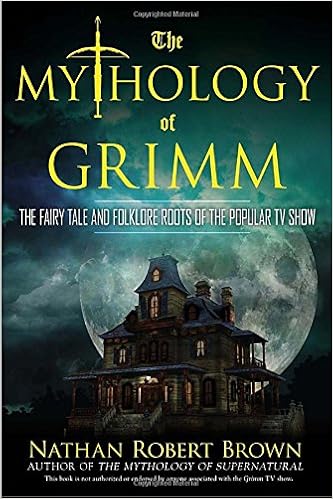
Book Review: The Mythology of Grimm (Nathan Robert Brown, 2014)

About a year ago, I received an uncorrected proof for a book called The Mythology of Grimm: The Fairy Tale and Folklore Roots of the Popular TV Show (The Berkley Publishing Group, 2014) from my good friend and author Nathan Robert Brown for review. I have always loved Nathan's books and his writing style, which combines liberal amounts of humor with thorough, scholarly research. When I found out that Nathan was looking for bloggers and volunteers to review the book, I naturally jumped at the chance! A couple of weeks later, an uncorrected proof arrived at my door. Although I had never actually seen a single episode of Grimm (2011 to present), I had a basic idea of what the show was about. However, I had absolutely no idea how much information Nathan had packed into a three hundred and forty-nine-page book, nor did I know how much fun reading this magnificent tome would be.

In The Mythology of Grimm, Nathan has not only covered the TV show and its mythology, but he also covers the legends, folktales, and the mythology behind the show with an enormous amount of detail. Each major type of Wesen gets their own chapter, along with a retelling of the specific fairy tale that they're associated with, as well as a deeper look into the meanings behind the fairy tale, comparisons between the Wesen in the show and the creatures in the folktales, the historical background of the stories, and the historical events that may have inspired the fairy tales to begin with. Nathan covers every type of Wesen seen in the first two seasons (which is all that the book covers), including Blutbaden, Fuchsbau, Jagerbars, Geiers, Siegbarste, Reinigen, Damonfeuers, Ziegevolk, Bauerschwein, Hexenbiests, Lowen, Murcielago, Musai, Wendigo, La Llorona, Skalengeck, et al. There's even a chapter on the weapons found in Grimm, not to mention a very helpful Glossary of Wesenology and a Glossary of Grimm Terminology. Both of these glossaries include the pronunciation of the terms (very useful if you don't speak German), an English translation of the term, and a short description of the term, as well as the name of the episode and the particular season that it can be found in. A brief biography of Wilhelm and Jacob Grimm can be found within these pages (although "brief" is a very relative term here), as well as information on Charles Perrault and Joseph Jacobs, both of whom expanded and added to the Grimm universe with their works. In short, this book is a must-have for all Grimm fans!

Overall, The Mythology of Grimm is fantastic!! I have spent many nights reading this tome, pausing only to laugh at Nathan's inimitable sense of humor. If you've never seen the show, you'll want to after reading this book! I honestly cannot recommend the book enough. The only problem that I have with it is that the book itself only covers the first two seasons of Grimm. But then again, that's still a lot of material to cover, even for just two seasons. You may purchase a copy from Amazon here. I strongly recommend that you buy a copy, and soon. Now, I wonder if there will ever be a sequel...?

Thursday, August 6, 2015

The Acheri

In cultures throughout the world, people believe that there are demons, ghosts, and monsters that are responsible for unleashing deadly, infectious diseases on innocent people. Most of these plague-bearers are hideous to behold, but there are exceptions. Some appear in the most innocent forms in order to walk amongst humanity and to spread death amongst them. One such spirit exists in both Native American folklore and Hindu mythology, possibly due to European confusion regarding the term “Indian”. She is known as the Acheri, and she comes down from the mountains at night, spreading a virulent sickness wherever she goes. Death inevitably follows with her passing.

In both Native American (mainly Chippewa) and Hindu folklore, the Acheri is the ghost of a little girl who died a painful death from a contagious disease. In other legends, the Acheri is a small girl who passed away as the result of a “bad death”, meaning that the poor girl was murdered, abused and then murdered, or was brutally beaten and left to die from her injuries. She appears as a gaunt young girl, having pale gray skin and wearing worn deerskin or cloth clothing. Her frail, sickly appearance creates feelings of sympathy in both other children and adults alike, fooling them into believing that she is only a very sick little girl who needs their care and friendship. This is how she lures her victims in close enough to spread her disease. The Acheri’s true form, however, is both monstrous and frightening. She manifests in this form with a skeletal body, red eyes that glow with a demonic malevolence, long clawed fingers, and sharp, gnashing teeth. But her true form is rarely seen, as she only assumes this visage when she is cornered and has no other choice otherwise but to attack.

The Acheri has a simple agenda, and that is to spread her plague to living humans and to kill as many innocent people as she possibly can. This disease is known simply as Acheri’s Shadow, and it is both highly infectious and extremely contagious. She is attracted to human movements, and will follow anyone who catches her interest down from the peaks of her mountain home. The Acheri is nothing if not patient, and merely bides her time until a community gets together for a harvest celebration, a festival, or even a funeral (the Acheri is opportunistic as well as patient). During these times, the Acheri will enter the village while she merrily sings and dances, although sometimes she is seen playing the drum as well. Seeing her dancing and hearing her singing or drumming are ill omens of misfortune or death to come. Once she has entered the village, she seeks out children and befriends them. While they play together, the Acheri casts her shadow over the unwary children, although the disease can be spread by her touch as well. This act infects the poor children with a terrible disease that can take a variety of forms. Most commonly, the disease is a horrible wasting sickness that is incurable and ultimately results in death. In his excellent book Vampire Universe (Citadel Press Books, 2006), Jonathan Maberry writes that “the very touch of the Acheri’s shadow is like the breath of a highly communicable respiratory disease; infection occurs instantly and spreads rapidly throughout the community” (Maberry 5). This plague is capable of wiping out entire villages, and all the while the Acheri vampirically feeds on the despair, pain, misery, and death created by the outbreak (Maberry 5).

The Acheri desires nothing more than to see the living suffer as she did before she died, making her a sort of vengeful ghost. However, this spirit isn’t known for targeting individuals and very rarely seeks out her killers outright. And with each person that the plague kills, the Acheri grows even stronger. Only if an adult notices the Acheri will she retreat back to the mountains, and even then the Acheri may try to lure the children back into the mountains with her, where they will meet a grisly, painful death at the Acheri’s hands. She is said to fly over inhabited valleys late at night, throwing her shadow over children as they sleep (hence the disease’s name), and the children will grow sick and eventually die from her plague.

As deadly as the Acheri is, she does have a few weaknesses. However, they are limited to one or two things. The most common defense against this vengeful spirit is items which bear the color red. Placing amulets, necklaces, or bracelets of woven red thread on one’s person will thwart the Acheri’s attentions, as will red beads, ribbons, embroidery, and clothing. Even being a natural redhead might work, although this theory is speculative at best. It is also said that salt will keep this spirit at bay. Salt, due to its purity and pure white color, is thought to be a very potent defense against evil spirits and all sorts of supernatural beings. Salt can be used to line the boundaries of one’s property, and can be carried around in leather pouches by children. But the best possible defense against the Acheri would be a red cloth bag, filled with salt and hung around one’s neck with a cord of woven red thread.

Unfortunately, there are no known methods that can be used to destroy the Acheri. Some legends do suggest, however, that she can be put to rest. According to folklore, the Chippewa believe that wrapping a red cloth that has been blessed by a medicine woman around the spirit’s neck will cause the ghost to dissipate and find eternal rest. But good luck getting close enough to the spirit to do this without contracting the sickness she carries. Either that, or the Acheri will reveal her true form and tear the would-be hero to pieces in a flurry of ripping claws and teeth.

If the Acheri cannot be laid to rest, then she must be placated or otherwise appeased. This can be done in a couple of different ways. According to Hindu tradition, one way to do this is to build an altar. Then, the altar is filled with lit candles and delicious cakes. Then the altar must be carried to a remote, seldom-visited location. Hopefully, the Acheri will follow this offering to that location and cause her anger to wane. It may also encourage her to return to the mountains. Another method is designed to encourage her to remove the sickness that she has inflicted upon the people. This involves vigorously beating on a brass dish, which is intended to send one of the spirit’s victims into a trance (or it might just give them a headache), which will cause frenzied dancing on the victim’s part. In this trance, the victim will gain insight and know what sacrifice must be made in order to appease the Acheri’s anger. Hopefully, the sacrifice will cause the disease to recede and the Acheri to go away. But be warned: neither of these methods is guaranteed to work, and thus the best solution might be to just run.

Today, the horrifying legend of the Acheri has been all but forgotten. Advances in both science and modern medicine have rendered such beliefs obsolete in the modern world. And yet, the belief that diseases and sickness are caused by supernatural evil still runs rampant around the world today. What if there is something to those beliefs? Once people have accepted that possibility, then the existence of evil spirits like the Acheri doesn’t sound so far-fetched anymore…does it?

Sources

Maberry, Jonathan. Vampire Universe: The Dark World of Supernatural Beings That Haunt Us, Hunt Us, and Hunger for Us. New York: Citadel Press Books, 2006.

Ramos Jr., Octavio. “Monster of the Week: Acheri.” Examiner.com. 1 May 2011. 6 August 2015. <http://www.examiner.com/article/monster-of-the-week-acheri>

Black, Andrew. “Acheri.” The Mask of Reason. 6 August 2015. <https://maskofreason.wordpress.com/the-book-of-mysteries/know-your-ghosts/north-america/acheri/>

Hume, Nic. “Acheri.” The Paranormal Guide. 14 December 2013. 6 August 2015. <http://www.theparanormalguide.com/blog/acheri>

“The Acheri.” BEAR Nation Online. 7 February 2012. 6 August 2015. <http://bearnation.forumotion.com/t13-the-acheri>

Alex. “Acheri (MYTHOS).” Everything2.com. 13 March 2002. 6 August 2015. <http://everything2.com/title/Acheri>

Wednesday, July 29, 2015

Book Review: The Zombie Book (Nick Redfern and Brad Steiger)

About a year ago, I received a new book from my good friend Nick Redfern, who has written over thirty books on monsters, cryptids and cryptozoology, UFOs, government cover-ups, conspiracy theories, and just about every conceivable mix of these subjects. The book in question is The Zombie Book: The Encyclopedia of the Living Dead, and it happens to be one of the most comprehensive works available on zombies today! People today are utterly fascinated by the concept of the flesh-eating walking dead, but most of them don't realize that this phenomenon is much older and goes much deeper than the majority of these people are inclined to believe. The phenomenon itself actually goes back to ancient Sumeria and the world's oldest known literary work, The Epic of Gilgamesh. In a fit of anger, the goddess Ishtar declares:

"Father give me the Bull of Heaven, 
So he can kill Gilgamesh in his dwelling. 
If you do not give me the Bull of Heaven, 
I will knock down the Gates of the Netherworld, 
I will smash the doorposts, and leave the doors flat down, 
and will let the dead go up to eat the living! 
And the dead will outnumber the living!"

This is where the modern concept of the zombie originates. Getting back to the review, this book treads into some truly strange territory and covers just about everything, from Vodoun, diseases that might be capable of creating a zombie plague, zombielike monsters and entities, Nazi reanimation experiments, and the 2012 MacArthur Causeway Incident, to the Wendigo, zombies in popular culture (there are a multitude of entries devoted to zombie movies and literature), zombie preparedness, the apocalypse, zombie folklore and mythology, zombies and extraterrestrials, death and burial practices, and cannibalism. There are even some thought-provoking parallels presented to the reader regarding the Lord Jesus Christ and zombies. Nick's co-author Brad Steiger also presents some great material from his book Real Zombies, the Living Dead, and Creatures of the Apocalypse (2010). The only issue that I have with this book is that there seems to be no entry in the book that is specifically dedicated to how to destroy or otherwise kill a zombie other than an entry on Decapitation and Reattachment. But then again, any hardcore zombie fanatic should automatically know that the only real way to kill a zombie is to destroy the brain. Consequently, this isn't a huge deal if you know your stuff.

Overall, this book is fantastic! The amount of detail and research in this book is simply amazing, and I cannot recommend it more. I wouldn't hesitate to buy a copy if the need should arise, and neither should any of you, my dear readers. I would like to take this opportunity to give my sincerest thanks to Nick Redfern for being kind enough to send me an autographed copy of this book, for putting up with my seemingly endless questions, and for helping me with my own research. Nick, you are a true friend, and I cannot thank you enough for your friendship and your kindness! Thank you for all that you've done for me, and I hope to repay you for that someday. Thank You!!