Monday, May 16, 2011

The Borego Phantom

The Borego Phantom is a skeletal apparition that appears to potential gold-seekers between Borego, Arizona and the foothills of the Superstition Mountains.

The Borego Phantom manifests itself as a humanoid skeleton, standing well over eight feet tall and appearing only after darkness falls. Within the Phantom’s chest is a fiery lantern that burns brightly, swinging slowly from side to side from the rib from which it hangs. Despite this, the apparition appears without warning and appears suddenly from the darkness.

In most cases, the Borego Phantom seems uninterested in mortal affairs and simply wanders past terrified onlookers. Its feet may touch the ground and kick up sand, but no footprints of any kind are ever left behind, nor can it be followed for any amount of time. But when traveling through cactus stands, over boulders, or through narrow tunnels, the Borego Phantom has exhibited incredible agility that is rare among the undead.

The Borego Phantom may be an aimless wanderer, but the irrefutable fact that it appears only to miners and prospectors indicates that the apparition may in fact have some sort of motive. The lantern in its chest and its choice of witnesses indicates that the Phantom was once a prospector who had died while searching for the legendary Lost Dutchman Gold Mine, but it is also possible that the Phantom is a “collective phantom,” created and empowered by the ghosts of the innumerable people who perished in pursuit of the Lost Dutchman.

History

The Borego Phantom is a spectral entity that is said to wander the desert wastelands between the Superstition Mountains and Seventeen Palms. A few years back, it is said that a gold prospector named Charley Arizona had decided to settle down for the night in an area about four miles southeast of Borego. In the early hours of the morning, Charley was suddenly awoken by something in the dark. He decided to investigate, thinking that someone had stumbled upon his camp. In the distance, he saw a faint, eerie glow, perhaps a torch. Now he thought that a lost traveler had found his campsite. As the eerie light drew closer, Charley could begin to make out a figure in the darkness. What he saw would haunt his memories for the rest of his life...

Charley stared silently in terror, unable to make even a single sound. A large, gaunt skeletal figure traveled noiselessly across the desert sands, and a bright light, like a lantern, dangled from the ghost's ribs. The figure was over eight feet tall, the light from it's ribcage casting a creepy glow in the stillness of the night. As quickly as it came, the apparition faded from sight behind some large rocks. Charley remained motionless with fear for the rest of the night, unable to sleep...

Two years later, two prospectors in the area reported a sighting of the mysterious entity whilst camping out for the night. One of the men claimed to have seen a dim light in the darkness, and was then approached by a gigantic skeletal figure with a lantern in it's chest. His companion was skeptical, and dismissed the sighting by saying that the other man only saw the glow of the fire reflecting off of the rocks. A year later, however, another man who was making his way through the Superstitions encountered the entity as well, describing it as a clumsy, stumbling skeleton of immense proportions, with a light emanating from it's chest. The man promptly recounted his experience at the Vallecito Station, where rumors of this terrifying apparition began to spread rapidly. Thus, the legend of the Borego Phantom was born. Thrill-seekers began to journey recklessly into the Superstition Mountains, hoping that they would somehow catch a glimpse of the dangling lantern and it's eerie glow that preceded the ghost's appearance. All that awaited them, however, was terror beyond measure...

One particular group of ghost hunters encountered the apparition at night when they had set up a night watch. When they saw the Phantom, one of the men fired his gun at the specter, only to have the bullet pass through it. They could only watch as the ghost stumbled and tripped awkwardly across the sands. They attempted to follow it, but eventually lost sight of it in a valley.

Most people believe that the Borego Phantom was once a prospector who searched for his fortune in a local mine, but died in the process. They believe that he is now cursed to be the guardian of the Lost Dutchman, and that he will lead anyone astray who comes even remotely close to the mine and the treasures within, but at the same time also seeking the mine himself. Others believe that the entity is only seen by miners and prospectors, or by those who have some sort of connection to the mine itself. Either way, this skeletal phantasm should be avoided until it's true nature and it's purpose is discovered. It has not been seen in recent years, but that doesn't mean that the Borego Phantom doesn't still walk the dunes...does it?

References

Blackman, W. Haden. The Field Guide to North American Hauntings: Everything You Need to Know About Encountering Over 100 Ghosts, Phantoms, and Spectral Entities. New York: Three Rivers Press. Copyright ©1998 by W. Haden Blackman.

Arnold, Neil. Monster! The A-Z of Zooform Phenomena. Great Britain: CFZ Press. Copyright ©2007 by CFZ Press.

Anza Borrego's Haunted Desert (DesertUSA)

Friday, April 29, 2011

Something in the Storm...

This year we in the United States have had a more aggressive winter than usual.

Depending on your geographical location you may have experienced a few feet to a few inches when you otherwise would have not experienced little or no snowfall whatsoever.

Here in Erie PA, we usually get our fair share of white out conditions and blizzards. In fact snowfall is so commonplace that many of the local residents do not even shovel their driveways until at least 6 inches fall. You get used to living and driving in many feet of accumulated snow.

But you never get used to the blizzards.

For we have Lake Effect Snow here in Erie, it is common place to have a foot or more of accumulated snow overnight multiple times during the season. But every decade or so this area gets blasted with a massive storm that shuts down the entire community. Even though equipped with fleets of government snow removal vehicles and scores of private snow plow businesses, these operators cannot keep up with the overwhelming snowfall.

This year the storms were bad, but in the mix there was no storm of a lifetime. Though snowdrifts of 7 feet or more were scattered throughout the region, there have been times that a rough wintry blast has left drifts up to 12 feet or more in many places. However what this season's storms lacked in volume, they made up with sheer force. The violent winds and driving snow brought down trees, damaged buildings and prevented anyone but the foolhardy or daring and resolved emergency workers to venture forth into the tempest's grasp. I was one of those, delivering medicine to hospice patients during the heart of the storm, and I have to say that it was one of the worst conditions I have ever experienced. The driving wind blew the light snow that had already fallen and mixed it with the flakes that were still coming down to limit visibility to only a foot in front of my vehicle. I was surreal to suddenly see a jack knifed tractor trailer emerge from the blinding snow. It had tried to take a shortcut from the closed highway and landed in a 45 degree angle across three fourths of the road. The wind had blown it across the road and the ice prevented it's brakes from stopping it from ending in the ditch. My car shuddered throughout the whole trip, being hit by barrage after barrage of gusts from the mighty storm.

In the midst of it, knowing you were experiencing an unusual storm there were times you could feel like there was some willful force behind the gail. A destructive force of chaos that mercilessly cut a path across the country. Of course one would think this is a natural response, being faced with the raw poawer of nature is an awesome experience.

However within the last month I have received two e-mails that makes one suppose that perhaps there was something in the storm that was not wholly natural, at least as to what norms of nature that we are accustomed to. From "Jacob"

"...It was on this past December 19th, just less than a month ago. It was early morning and I always check on the chicken coop first thing. The wind was whipping hard and there was a huge pile of snow on the side of the shed. The wind had pushed almost all the snow from the field up to it. The wind was making a loud wild sound, and as I came up to the barn, I was sure that I was hearin something strange in the wind. I stopped there since I thought it could be a neighbor or some other stuck outside since it sounded like a human scream. It was not right though. It seemed really wrong, like wounded animal crying at the top of it's lungs but with a man's voice. All I could think of was someone stuck out in the storm, so I walked out to the field to see where the screaming was coming from. "

Jacob then recalls how he wandered into the field, and the location of the screaming voice seemed to always be out of reach. It seemed to always dwell just outside the edge of sight in the storm, and every time he turned away to give up in his search, the voice became more frantic. So he kept on his quest only to find himself caught up and lost in a blinding blizzard. It was then as his panic set in he believes he saw the source of the screams:

"It was like a big shadow in the blowing snow, I knew it was the person i was lookin for so I ran to it. then I saw how big it was. It was like a giant, almost twice the size of a man, but with a man's shape. It was either covered in fur or wore an animal fur coat because I could see the hair moving in the wind. As I got to it, the screamin became louder and louder, and from the sight of it and the sound of it I knew that this thing was just wrong. I had to get away from it as fast as possible. I ran as fast as I could and made sure the screaming thing was behind me. After a few minutes the snow was not coming down as hard and I found myself back in the field behind the shed. It was then that the screaming voice had stopped... I don't know what it was out there, but I knew I was in danger of my life, and that thing was not of this world. I think it was pure evil..."

Jacob was not sure what he had encountered last December during thst storm, but he is resolute ass to the reality of what he saw. He was sure he was not hallucinating or observing amirage due to the blinding snow.

Something evil was in the storm.

Something that tried to lure him to his doom.

So what was it? There are a lot of possibilities.

Immediately to me it brings to mind the mythological Sirens as portrayed in the greek classics of Homer and Ovid. However what Jacob saw was not a beautiful seductress, but a hideous monster like unto Typhon. Since this encounter happened in old Seneca Indian territory perhaps we should look into Native American mythology and the destructive wind spirit Dagwanoenyent of the Iroquois.

It's appearance is similar to a Sasquatch as well. Pennsylvania certainly has its fair share of Sasquatch sightings according to the Pennsylvania Bigfoot Societies reports.

Perhaps an exact nomenclatural designation for the creature is moot; as spirits do assume a different persona depending upon the circumstances. Be it Typhon, Dagwanoenyent, Set or Thor; the names may change but their mythological archetype speaks to us in the same basic way.

There is something in the storm. Something powerful, dangerous, and malevolent.

Comments

Could this have been the legendary Wendigo? The creature seems to possess most of the characteristics common to the way the beast is portrayed in legend. But perhaps we'll never know...

My personal thanks go to Reverend Robin Swope, the Paranormal Pastor, for graciously allowing me to borrow this article from his blog, which may be found at Something in the Storm (The Paranormal Pastor).

Friday, April 22, 2011

The Popobawa

Whereabouts
Zanzibar, Africa (although it has also been reported in Tanzania).

Ethymology

The name popobawa comes from the Swahili that translates literally as “bat-wing” (from the Swahili popo, “bat,” and bawa, “wing”). It is also known as Imran, Khalid Khanzada, or zain haiders.

Vital Stats

The Popobawa is variously described as a ghost or a demon with a single eye, gigantic bat wings, and an enormous penis (said to be up to six feet in length). It is thought to be a shapeshifter, appearing as a normal man by day and changing into a batlike demon at night.

Behavior

The Popobawa is much like an incubus, but unlike that particular demon, the Popobawa attacks men in their own beds. As a result, many men take to sleeping outside of their houses in the streets or on their porches. The creature attacks the men while they sleep, overpowering them. Then, it holds their faces to the floor and forcefully sodomizes them for up to an hour (an extremely painful experience for anyone). It then threatens the victim with repeated and longer attacks if they don’t let friends and neighbors know of their experience. It then flies off into the night to search for another victim. The creature’s presence is usually detected by the sound of scraping claws on the roof and a sharp, pungent odor (although some report that there is a puff of smoke as well). It is thought by skeptics that these attacks are the result of sleep paralysis, not a homosexual bat-creature.

The Popobawa, being a spirit, is able to take possession of human bodies. It becomes very angry if its existence is denied, and dire consequences usually follow. Usually, the Popobawa attacks skeptical men.

Abilities

The Popobawa is, as mentioned earlier, a shapeshifter. It is able to take on multiple forms, but it prefers human form. The Popobawa has a supernatural degree of strength, which makes overpowering full-grown men easy, and it is also able to fly at considerable speeds for great distances. It may also be able to become intangible and glide through solid objects.

Vulnerabilities
It is thought that, by smearing oneself with pig’s oil, one can repel an attack from the Popobawa. Being an evil spirit, the Popobawa may be repulsed by salt and iron. Salt would keep it at bay, while the iron (which must be pure or cold-forged, preferably both) might actually harm the creature, and perhaps even kill it. For some reason, it is believed that the Popobawa cannot attack an individual who sleeps outdoors. Many also believe that the creature can be exorcised, kept at bay with charms, or placated with sacrifices.

History

The legend of the Popobawa is a fairly recent one. One popular story says that during the 1970s, an angry sheikh released a djinni to take vengeance on his enemies. However, he lost control of the creature and the djinni took to evil ways.

Another theory states that, because Zanzibar was once the site of Arab slave market, the Popobawa is the vengeful spirit representing the collective pain of the native people. Perhaps the creature is some sort of thought-form (but this is doubtful).

Recent Sightings
Unusually for a demon, the reports of the Popobawa’s attacks and sightings of the creature rise and fall with the election cycle in Zanzibar (although the spirit’s victims argue that the Popobawa is apolitical). The number of attacks rose dramatically in 1995 (the same year that the Chupacabra attacks began in Puerto Rico), and further attacks were reported as recently as 2007, when a series of attacks were reported in Dar es Salaam.

Relatives

The Popobawa may be related to another mysterious creature, El Chupacabra.

Sources

More research is forthcoming!

Demonic Possession

Demons, being spiritual entities, are able to take possession of human bodies, whether living or dead. Basically, demonic possession occurs when a demon or an evil spirit forcefully inhabits a human body (although some people are deranged enough to willingly comply with the possession). But the Roma people (Gypsies) believe that demons can also possess animals, the dead, plants, and even inanimate objects. The oldest known references to demonic possession come from the ancient Sumerians, who believed that all diseases, of both the mind and the body, were caused by "sickness demons" called gidim. Fortunately, these priests (known as ashipu, or sorcerers) were well-versed in being able to exorcize these spirits.

Most major religions and all cultures worldwide have some concept of demons and demonic possession, but these beliefs vary considerably, as do the beliefs regarding how to remove the possessing spirit. Symptoms of demonic possession include (but are not limited to):
•Missing memories.
•Convulsions and fits.
•Speaking in tongues (other languages).
•Unnatural strength.
•Access to and knowledge of previously unknown information.
•Drastic changes in tone of voice and facial expression, as well as in mannerisms and personality.
•Unexplained injuries (bites or scratches are common).
•Piercing eyes (sometimes said to be entirely black).
•Uncharacteristic aggression and antisocial behavior towards others.
•A blatant disregard for one's personal modesty or the modesty of others.
•An aversion to and a hatred of religious objects (i.e. crosses or a crucifix, as well as saintly medals).
•Self-mutilation (i.e. cutting or puncturing their own skin, just for the thrill of it). May be in the form of writing or specific symbols.
•Foul language (need more be said?).
•Exhibition of various supernatural abilities (i.e. precognition, telepathy, retrocognition, levitation, etc.).
•Multiple voices emanating from a single source (i.e. a person) simultaneously.
•Compulsively sinning or lying to others.
•Flinching at the spoken name of God (Deus or Christo in Latin).
•Unnatural sexual desires (necrophilia, bestiality, rape, or incest).
•Uncontrollable rage and violence.
•Mental or emotional problems (which may have attracted the demon in the first place).

Although this list is far from complete, there are innumerable physical and mental signs of possible possession. For those who understand such things, demonic possession is never a good thing or a positive experience. It is immensely harmful, both to the possessed individual (known properly as a demoniac) and their family, friends, and loved ones.

Sunday, December 5, 2010

The Nelapsi

The Nelapsi is one of the undead, a once-living deceased human without a soul, doomed to kill and feed on the living for its own sustenance. This thing from beyond the grave is also one of the most dangerous vampire species known to monster hunters. Typical for vampires, the Nelapsi usually inhabits cemeteries in Czechoslovakia and the surrounding countries in Europe.

The Nelapsi is a type of vampire, feeding on the blood of both humans and animals. It is never satisfied, and will not cease hunting until dawn (although the sun’s rays cannot harm the creature).

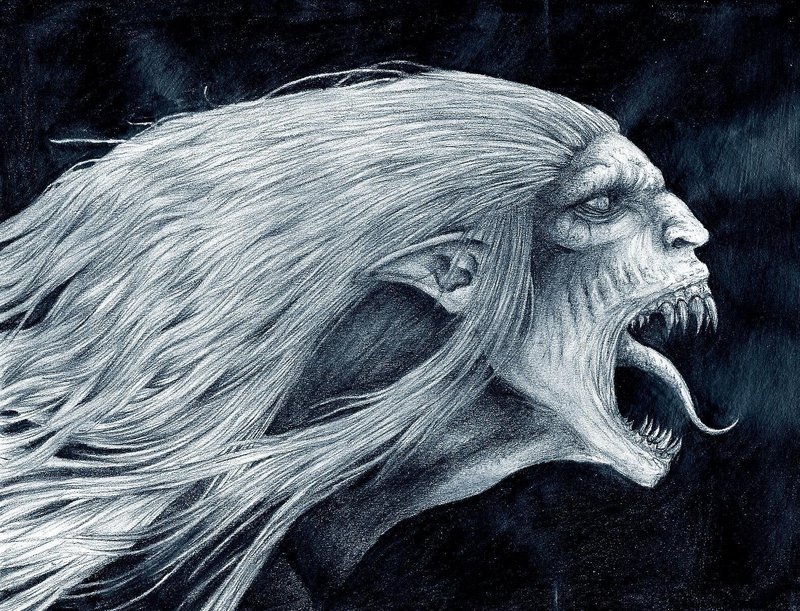
The Nelapsi is a walking corpse, although no signs of decay are usually evident. The creature has pale skin, a lean and muscular body, and sharp talons on its hands and feet. It has a head full of long, greasy black hair, and a mouthful of needlelike fangs. The creature may be dressed in the tattered remnants of its burial shroud or what remains of the clothing it was buried in, but more often than not, the Nelapsi stalks its prey completely naked.

One would be hard-pressed to find a vampire as vicious as the Nelapsi. This revenant delights in desecrating and utterly destroying villages, glutting itself on the blood of the villagers and their livestock alike. The only things left are wreckage and bloodless bodies. The Nelapsi prefers to kill by tearing into the victim’s neck with its needle-sharp teeth, or it will smother or crush its prey in a bone-crushing embrace. Any survivors (if any at all) are killed off by the plague that the Nelapsi inevitably brings. When angered, the Nelapsi will torture its victims and, being a devious and patient predator, can make the torture last for weeks before killing and feeding on the unfortunate victim.

The Nelapsi is among the most powerful of the vampires found in folklore and legend. The Nelapsi possesses supernatural strength and speed, as well as a phenomenal degree of endurance and agility. When cornered by vampire hunters, the Nelapsi has the power to kill with a fierce glare from its burning red eyes, or it may choose to fight with its formidable claws and teeth. As mentioned earlier, the revenant carries a virulent disease wherever it goes, and the resulting plague kills any survivors.

It is said that the Nelapsi has two hearts and two souls, making the revenant extremely difficult to kill. Conventional weapons like firearms and blades do little more than annoy the Nelapsi, more often than not succeeding in arousing the creature’s anger. At best, ordinary weapons are inadvisable.

As said previously, the Nelapsi is extremely hard to kill as far as vampires go, so one of the best defenses is to prevent the creation of the creature in the first place. One way is to purposefully bump the deceased’s coffin on the threshold while carrying the dead out of the house for burial. This supposedly knocks off any lingering misfortune or evil spirits, so that demons will not become attracted to the coffin’s occupant.

Seeds from the opium poppy (papaver somniferum) should be sown inside and outside of the grave, as well as along the road leading back to the village. Millet seeds should then be used to fill the mouth and the nose of the corpse. Like many vampires, the Nelapsi is compelled to stop and count each and every single seed. Some legends say that the flower of the opium poppy should be placed inside the coffin, causing the revenant to fall into a narcotic stupor that should make the Nelapsi unwilling or unable to rise from the grave. This may not actually work because, according to folklore, if the Nelapsi has been around for some time and fed often enough, the revenant’s intelligence increases. It will recognize the trickery and will not fall for it (although it may laugh). Therefore, this may not work.

To finish the preventative ritual, iron nails are driven deeply into the arms and legs of the corpse, effectively pinning the body to the coffin. Smaller nails are used to secure the hair and the clothes as well, and the jaws are bound shut with a stout leather strap. Vampires are known to engage in manducation, or the eating of one’s own flesh, from time to time. This feeding will give the vampire enough strength to smash through its coffin and claw through six feet of lose earth to the surface, so this practice was necessary. Although the Nelapsi is not harmed by sunlight, the creature cannot be out during daylight, and this is when the creature is at its most vulnerable.

When all else fails, there is no other choice than to destroy the Nelapsi. First, one must locate the grave. A young virgin (usually a boy) was placed on the back of a snow-white horse that had never stumbled. The horse is then walked through the entire cemetery, until the horse reaches a grave, which it refuses to step over. This is the vampire’s grave, which is then dug up (sometimes taking hours at a time). When the Nelapsi is exposed, a long stake of blackthorn (a relative of hawthorn) is driven through the revenant’s heart or its skull (usually the skull). However, this doesn’t kill the creature, but only immobilizes it. A sword is then drawn and, with a single stroke, the swordsman quickly decapitates the revenant. Fresh garlic cloves are then stuffed into the mouth and scattered throughout the coffin. Garlic was believed to sever the bond between the evil spirit and the corpse. At this time, the body could be reburied. The head was then placed facedown between the legs. If any doubt remains, the creature’s body and head must be thoroughly burned, and the ashes scattered to the four winds.

As for actually engaging in a fight with the Nelapsi, it is unknown if blessed weapons, silver, holy water, or holy icons will work on the revenant. Getting close to the Nelapsi is very strongly discouraged unless the Demon Hunter is supremely confident in his abilities (or has a death wish). Even then, care must be taken. It is recommended that the aforementioned methods be tried to test their efficacy, but it is best to be entirely prepared.

To cleanse a village of the revenant’s evil, a bonfire is lit, using only new wood. Effigies of evil creatures (vampires, werewolves, witches, etc.) are thrown into the fire, along with any animals suspected of being the Nelapsi’s familiar or that came into contact with the creature. Once the fire has burned down, the villagers and their livestock quickly walk through the smoke and ashes, believing that this act purifies them of the Nelapsi’s taint. Each villager takes some of the still-glowing embers from the bonfire home with them, using them to restart their hearth-fires. The ashes from the fire are then cast over the fields and along the roads as a final precaution against evil and the Nelapsi itself.

Among the most feared of all vampires is the Nelapsi, an undead abomination hailing from the European country of Czechoslovakia. Although no evidence is known from folklore, one is inclined to believe that the Nelapsi is the corpse of a suicide, murderer, or a practitioner of the dark arts, reanimated by a demonic spirit from Hell. The result is a sadistic, gluttonous undead monstrosity with an insatiable need for blood, and the bond between the demon and the flesh is so strong that the Nelapsi is virtually unkillable by conventional methods. The thing is, the Nelapsi enjoys every minute of it. The Nelapsi is still believed to exist to this day, arising from the grave when darkness falls to hunt and kill once more…

Sources

Maberry, Jonathan. Vampire Universe. New York: Kensington Publishing Corp. Copyright ©2006 by Jonathan Maberry.

Maberry, Jonathan. The Vampire Slayer's Field Guide to the Undead. Canada: Strider Nolan Publishing, Inc. Copyright ©2003 by Jonathan Maberry.

The Craquehhe

The Craquehhe is one of the undead, a creature that was once human but now exists beyond death without a soul, doomed to kill and feed on the living for its own sustenance. It is a revenant, a restless reanimated corpse.

Habitat

The Craquehhe inhabits old graveyards in France.

Diet

The Craquehhe is purely anthropophagous, feeding on both the flesh and blood of its unfortunate victims.

Features

The Craquehhe’s appearance bears very little resemblance to what the creature may have looked like while it was still alive. This revenant is a decaying corpse, having bloodless wax-white skin, sunken red eyes, and greasy hair clotted with grave dirt and infested with maggots. Maggots and other insects infest and crawl through the rotting tears in its flesh and infest the creature’s tattered clothing. The revenant’s hands and fingers are badly torn from the efforts of slowly clawing its way out of the grave. What is more terrifying yet is that, no matter how badly the Craquehhe was injured before death, it will walk and seek out living prey all the same. The Craquehhe has been seen shambling forth on shattered legs, with missing limbs, and other massively disfiguring or debilitating injuries.

Behavior

The Craquehhe shambles along rather like a zombie, but the revenant’s clumsy gait is deceptive, belying the incredible speed it possesses when attacking. It will greedily devour any human parts, and the creature will not stop until its stomach is bloated and full, leaving only a few scraps of flesh and a skeleton behind. Like the majority of the undead, the Craquehhe rises from the grave after sunset, clawing through the dirt to the surface, and then proceeding to hunt for living prey. This creature has been known to utterly destroy nearby towns in its constant search for food.

Abilities

The Craquehhe is one of the most savage and powerful of the Undead. It possesses supernatural strength and speed, despite being a rotting corpse. It has been known to destroy entire towns, preying on the townsfolk. Because it is a decaying corpse, the Craquehhe may be capable of spreading a virulent, highly contagious disease when it attacks. This plague will kill any who may have survived the revenant’s initial attacks.

Being truly dead, the Craquehhe is completely impervious to pain and injury. Gunshots and dismemberment will slow the creature down, but cannot stop the revenant. Even if somehow cut in half at the waist, the creature still clings to unlife, attempting to hunt all the same.

Weaknesses

For all of its savage ferocity and sheer power, the Craquehhe can be destroyed and has a few weaknesses as well. The creature cannot abide by the presence of consecrated icons (like a crucifix), and such a symbol of light and purity offers great protection against the creature.

Slaying the Craquehhe

Only two things can truly destroy the Craquehhe: fire and decapitation. To accomplish this seemingly foolhardy task, one needs highly-skilled and courageous men armed with consecrated icons, swords, axes, a great deal of courage, and faith in God. Either that, or an angry mob equipped with torches and sharpened, fire-hardened wooden staves (or pitchforks, whichever works). The revenant should be pinned to the ground with the wooden staves and decapitated with a single stroke of the sword. However, even headless, this ungodly creature will stubbornly cling to unlife. It is best to be sure if the creature is really dead before the next step is taken.

Afterwards, the Craquehhe needs to be cremated completely, and the ashes should be scattered to the four winds. Failure to burn the creature will result in the Craquehhe’s resurrection, or worse yet, the revenant’s taint will spread throughout the graveyard, creating a host of these undead monsters.

History

France may be a beautiful, picturesque country, but like any other place in Europe, the French have their share of dark evils. One of the most feared of these evil beings is the Craquehhe, a horrifying revenant that rises from the grave in order to feed on the flesh and blood of the living.

How does such an undead abomination come into existence? If a person dies unbaptized, he was never accepted as one of God’s own. If one were to die without repenting of one’s sins, he is rejecting Christ’s sacrifice on the Cross, and is therefore damned to suffer eternally in Hell. In either case, the result is an aberrant revenant known as the Craquehhe. This creature is said by some to be a form of vampire, but in truth, this revenant is much closer in relation to the cinematic Zombie. This creature is extremely formidable, and fighting the revenant alone is strongly discouraged, at least for the beginning Demon Hunter.

References

Maberry, Jonathan. Vampire Universe. New York: Kensington Publishing Corp. Copyright ©2006 by Jonathan Maberry.

Maberry, Jonathan. The Vampire Slayer's Field Guide to the Undead. Canada: Strider Nolan Publishing, Inc. Copyright ©2003 by Jonathan Maberry.

Tuesday, July 27, 2010

The Mummy (Undead)

Other Names

The Ancient Dead

The word “mummy” comes from the Arabic word mummia, which means bitumen. Bitumen is a naturally-occurring tarlike substance that the Arabs mistakenly thought was used for mummification due to the dark color of the mummies. Only later, in the New Kingdom, was bitumen used in the process.

Habitat

Mummies primarily dwell in Egypt, where they hide in the Great Pyramids, tombs, mastabas (mud-brick tombs), and forgotten temples. However, mummies are by no means limited to Egypt alone. They can be found all over the world (although one may be hard-pressed to find a living Mummy in any place other than Egypt).

Features

The Mummy appears as a shambling, desiccated corpse wrapped in soiled linen bandages. Underneath the bandages, the rest of the body is extremely well preserved, but is entirely dried out. The eyes are red, and glow in the dark. Usually, the Mummy has some kind of amulet hanging from its neck, as this may be the source of the creature’s power.

Behavior

Much of the time, the Mummy lies at rest within its tomb. However, when an intruder invades the tomb or disturbs the creature’s eternal rest, the Mummy awakens in a rage, seeking out and attempting to destroy the intruder.

Abilities

Once the Mummy is reanimated, it possesses a host of supernatural powers at its disposal. The Mummy possesses supernatural strength and endurance, far greater than it possessed in life. The Mummy is nearly indestructible, as bullets have no effect on it. Most blades are unable to penetrate the Mummy’s desiccated flesh, stemming from the supernatural power reanimating the creature’s body. Any abilities that the Mummy possessed in life (like magic) are usually retained in death.

Many of the Mummy’s abilities depend on who the Mummy was in life. For example, the Mummy of a pharaoh or high priest may be able to assume the form of a swarm of scarab beetles or become a thick cloud of desert sand. The Mummy might even be able to summon plagues of biblical proportions, or even command lesser mummies or other forms of the undead. Lesser mummies are extremely strong and relentless, little more than single-minded killers.

But for all the Mummy’s powers, perhaps the most feared of the Mummy’s abilities is the Mummy’s Curse. When an intruder steals from the tomb or even sets foot inside of it, the Mummy may choose to curse the individual, depending on the severity of the would-be thief’s crime and how angry the Mummy happens to be at the moment. The Mummy is bound by sacred law to consummate the curse, at which point it will relentlessly pursue the individual until they lay dead at the Mummy’s desiccated hands. If the Mummy is unable to pursue the individual for some reason or another, the thief will sicken and waste away. He will die, and rise from the dead as an undead servant of the Mummy.

Weaknesses

Despite the Mummy’s strength and immunity to pain, the creature is not without its respective weaknesses. While it cannot feel pain, the Mummy can be destroyed by a blast from a powerful firearm (like a shotgun). However, the Mummy’s major weakness is fire, a common weakness among the undead. Since mummies tend to be dry and coated with various oils and resins, the revenant tends to burn extremely well. Thus, fire is the only way to destroy the Mummy forever.

History

The Mummy has existed for thousands of years. Most of them never had cause to reanimate, but every once in a great while, one of these shambling undead arose from the tomb to take its revenge on those who would dare the wrath of Osiris and desecrate the Mummy’s tomb. To understand this undead creature, one must first understand how mummies were made and what could possibly cause the creature to reanimate.

Mummification

When the Egyptian religion was first being developed, the people realized that they needed a way to preserve their kings so that they would be recognizable to both the people and their gods eternally. Therefore, the process of mummification was developed over a period of centuries, and was finally perfected. The creation of a Mummy is a very complicated process, carefully developed through the centuries and involving mystic rituals that are still not completely understood today. Embalming is believed to have actually originated in Egypt, probably before 4,000 B.C. Although there are at least three different methods of mummification, only the most important and elaborate will be discussed here.

Several different tools and materials were needed for mummification. Among these tools were bronze knives, hooks, and a blade of obsidian (a naturally-occurring volcanic glass). The materials needed included myrrh, cassia, frankincense, and the resins of the pine, fir, and cedar trees. Others included an assortment of oils, from juniper, cedar, lettuce, and castor, but the key ingredient in mummification in natron.

Known in Egyptian as netjry, or “divine salt,” natron is a naturally-occurring salt compound composed of sodium chloride, sodium carbonate, sodium bicarbonate, and sodium sulphate (basically table salt and baking soda) that occurs in dried lakebeds in the Nile’s western delta, today known as the Wadi Natrun. Used while dry, natron is a powerful desiccating agent, absorbing bodily fluids as well as dissolving fat. It was used to completely dehydrate the body so that it could be mummified.

Now, as for the actual process, it is very complex and time-consuming. First, a long bronze hook or rod was pushed into the nose, breaking through the ethmoid bone and into the cranial cavity. The brain was then stirred with the hook, and using the hooked end, the brain was removed through the nostrils, one piece at a time. They then discarded the brain (they believed that an individual thought with his heart and not with his brain). Next, using an obsidian blade, an incision was made in the lower abdomen (usually the left flank), through which the liver, the intestines, the lungs, and the stomach were removed. These were the parts of the body that decayed the quickest after a person’s death, so their removal was imperative. The slitter (the embalmer who made the incision) ran away quickly, all the while being pelted with stones and cursed at by the other embalmers. They viewed this as a sacrilegious assault upon the body. After the vital organs were removed, only the heart was left untouched.

The vital organs were then separately embalmed and placed in four sacred canopic jars. The incision was then thoroughly cleaned and washed out, first with palm wine and then a mixture of ground spices. The incision was then filled with myrrh, cinnamon, cassia, and all other manner of aromatic substances (with the exception of frankincense), and small linen bags filled with natron were inserted into the body. Then the body was placed on a slanted embalming table, covered in natron with a channel carved into the bottom of the table (through which bodily fluids would drain into a ceramic jar). Afterwards, the entire body was covered in a thick layer of dry natron, from head to toe. Other than regularly replacing the natron (which lost its desiccating properties until dry), the corpse was left alone for forty days to allow the body to become completely dehydrated.

After this period, the desiccated corpse was removed from the natron, and the body was then washed in spiced palm wine, while various oils were rubbed into the dried skin of the corpse to restore some degree of flexibility to the limbs and to deodorize the body as well (resin was also used for this purpose). The cranial cavity was then filled with melted resin. The stuffing was removed from the flank incision and was replaced with bundles of linen and resin to give a more lifelike appearance (this was also done to the face). The abdominal incision was then stitched up, thus completing the basic process of mummification.

Next, the corpse had to be wrapped. First, it was placed inside a linen shroud. Then, hundreds of yards of linen bandages were used for one Mummy. The embalmers painted warm resin onto the bandages to help them stick to the desiccated skin of the Mummy. First, the arms and fingers were carefully wrapped. Then they wrapped the legs and the toes. Then, they wrapped the rest of the body. Every layer, the Mummy would be painted from head to toe in warm resin, and then wrapping would start again. As many as twenty layers of linen bandages could be used on one Mummy. Protective amulets (many made of precious metals and semi-precious stones) were slipped in between the wrappings to protect the body from any mishaps. The Mummy was then adorned with some of its favorite jewelry from life. After the body was bandaged, it was placed inside its coffin, and molten resin was poured over the body. The Mummy, at last, was completed.

As part of the accompanying funeral, the priests performed several mystic rituals, but the most important of these rituals was the Opening of the Mouth ritual. This ritual was meant to reopen the mummy’s eyes, mouth, and ears so that the Mummy would be able to eat, drink, speak, and enjoy its afterlife. With an adze, the priest touched the mouth, hands, and feet of the Mummy, as well as those of the tomb’s statues, wall paintings, and models. This was done so that the Mummy’s spirit could enter and restore life to the deceased individual, and so that the aforementioned inanimate objects could be animated and act on the Mummy’s behalf. After much grieving and lengthy ceremony, the Mummy was then buried. All in all, the entire mummification process took seventy days. The first forty were used to mummify the corpse, and religious rituals occupied the last thirty days.

The Concept of Reanimation

Typically, mummies do not reanimate. However, there are exceptions. The Egyptians believed that a man (or woman) was composed of several different types of souls. Respectively, there were at least nine different aspects of the soul, but only a few have been identified. These aspects of the soul were known as the ba (the personality), the ka (lifeforce), and both were known collectively as the akh. Other aspects included the shuyet (shadow) and the ren (name). An attempt shall be made for an explanation.

The ba is but one part of the soul, the aspect of an individual that made that person unique, a personality of sorts. It is the part of the soul that is able to detach itself from the body and roam independently by means of astral travel. It was primarily released after death, but it could also be released under circumstances while the individual was sleeping (which was seen by the Egyptians as a state akin to death). Although this aspect was supposedly incorporeal, it was apparently able to eat, drink, and speak, as well as move. Despite this, the ba had to return the body every night, or otherwise the Mummy would be unable to survive into the afterlife.

The ka is the lifeforce, a sort of spiritual double or doppelganger. It gives each individual their nature, temperament, and character. The ka is created at birth, living through the individual’s life and beyond their death. It is the energy that animates a living person, and perhaps it is also the force that is capable of reanimating the desiccated flesh of the Mummy as well. It continued to exist only as long as it was provided with the necessary care and sustenance. The ka was given daily offerings, and it was the one which partakes of the food and drink offerings buried with the Mummy.

However, there was the belief that the ka was able to leave the body and wander about, especially if it was not sufficiently provided for. The ancient Egyptians feared that the ka would rise from the grave in a corporeal form as one of the Undead (known to the Egyptians as the kamarupa), clad in its burial clothes, and wander about at night in search of its own food, in the form of human blood, decaying animal flesh, brackish water, or even faeces. Nobody was safe from this walking corpse.

In order for the dead to achieve true immortality, the ka and the ba had to be reunited in the afterlife. Collectively, these two aspects were known as the akh. This was the eternally unchanging and enduring spirit of the deceased, dwelling in the Underworld for eternity. It was seen as an eternal, living being of light, closely associated with both the stars and the gods (with whom it shared some characteristics, but was not truly divine itself). However, not everyone could become an akh. Those that had not lived their lives according to maat (the concept of cosmic order, truth, and justice, personified as a goddess, and the principle at the very heart of ancient Egyptian religion and morality) would either be annihilated or would not pass into the afterlife. These individuals were especially at risk of joining the ranks of the undead.

To become an akh, one had to die first, and completing the process symbolized a successful resurrection and rebirth, transforming from a mortal into an immortal. The akh of the pharaohs (considered to be living gods in their own right) shared the divine power of the gods, and were therefore more divine than their subjects, and thus were far less likely to rise from the grave (although it could still happen).

The ren, or name, of an individual was extremely important, in both this life and the next. A name provided an individual with an identity, and without a name, the individual would utterly cease to exist. To the Egyptians, this was the worst possible fate that they could imagine, and therefore went to extremes to safeguard their names. If one’s name were erased on purpose, the family of the deceased feared for their eternal existence. It was considered to be an effective means of ridding oneself of society’s undesirables forever. In Egyptian magic, knowing an individual’s true name gave one power over that individual. This obsession was common all over the world, and it is still a concern in some cultures today.

The shuyet, or shadow, was said to be a powerful and quick entity in ancient funerary texts, and is due the protection that it deserves. Shadows were thought to be an extension of the soul, and were also associated with the sun. The shadow’s solar associations were linked to the rebirth of an individual: the sun produced a shadow, an image of that person’s soul. When the sun set, the shadow disappeared. The shadow was then resurrected at dawn the next day, and therefore the sun helped the Egyptians to prepare for eternity in the afterlife, no matter what form the individual took.

As for actual reanimation, it is possible. The Egyptians actually expected the Mummy to reanimate and kill intruders. However, reanimation only occurs under certain circumstances, and requires a great deal of supernatural power. A curse, if potent enough, might have such power. To protect the tomb’s occupant (usually a pharaoh or a high priest), priests would inscribe protective spells or curses into the walls, possessions, and the sarcophagus to protect the Mummy from thieves and intruders, with dire consequences for those who dared to ignore them. A curse with sufficient power may force the Mummy’s ka back into the body, causing the desiccated corpse to reanimate. The Mummy is imbued with enough intelligence to know its purpose: drive away or kill all who dared to disturb the Mummy’s tomb. Only the ka was needed for this, as the other aspects would cause the Mummy to become self-aware and prevent it from achieving its purpose. Thus, the other aspects weren’t necessary. The end result was a shambling corpse of supernatural strength and completely relentless in its ordained task.

References

Brier, Bob. Ancient Egyptian Magic. New York: William Morrow and Company, Inc. Copyright ©1980 by Bob Brier.

Brier, Bob. Egyptian Mummies: Unraveling the Secrets of an Ancient Art. New York: William Morrow and Company, Inc. Copyright ©1994 by Bob Brier.

Ikram, Salima. Death and Burial in Ancient Egypt. Great Britain: Pearson Education Limited. Copyright ©2003 by Pearson Education Limited and Salima Ikram.

Redford, Donald B. The Ancient Gods Speak: A Guide to Egyptian Religion. New York: Oxford University Press, Inc. Copyright ©2002 by Oxford University Press, Inc.

Saturday, June 26, 2010

The Dybbuk

The Dybbuk is a type of malicious ghost hailing from Jewish folklore. The word dybbuk itself is derived from the ancient Hebrew language, meaning "to cleave to" or "to stick to." According to Jewish tradition, there are some souls so evil or that have committed such grievous sins during their life that they are unable to enter Heaven or Hell upon death. Instead, demons torment the spirits by with flaming whips and force these damned souls to wander endlessly all over the earth. Sometimes, these evil souls manage to temporarily escape their tormentors. Dybbuk are predominantly male, but they prefer to possess young women.

The Dybbuk is said to be able to possess any living or inanimate object. Although the spirit can possess animals, it prefers human hosts. Dybbuk possession may prove to be too much for the unfortunate animal, which may die of "natural causes" or a frantic attemp to drive out the invading spirit shortly afterwards. When the Dybbuk possesses a human, it absolutely refuses to leave. This person may be a total stranger, merely the best and the most convenient host the spirit could find. Legends tell of these spirits inhabiting horses and then jumping into the stable boy.

However, the Dybbuk can be exorcised. Certain magical or biblical verses may force the spirit to leave, but it is of the utmost importance that the Dybbuk be cooperative, or the host may possibly be hurt, perhaps even fatally. A rabbi experienced in this sort of exorcism must be found, who then must come to an agreement with the spirit. This may simply be a shortened duration of stay with the demons or an expiation of crimes and sins that will enable to possessing spirit to enter Heaven or Hell. However, if the exorcism isn't done in the right way, the host may be harmed or killed. If successful, the Dybbuk will be forced to evacuate the body from under the nail of the big toe, as this is where the least amount of damage will be caused to the host. Some Dybbuk remain silent in their hosts, usually without being detected for a long period of time. The host may act out of character at times, but in general the spirit tries its hardest to be quiet and remain secretive. Some are more forceful in asserting their presence: speaking from the host's mouth, speaking in languages unknown to the host, possessing knowledge that the host shouldn't even know, or even speaking in an entirely different voice. Some are arrogant, usually making demands and claiming that they can't be forced to leave. The most powerful of Dybbuks may require several exorcists, and more than one exorcism may be required to cast out the possessing spirit.

Sources

Illes, Judika. Encyclopedia of Spirits: The Ultimate Guide to the Magic of Fairies, Genies, Demons, Ghosts, Gods & Goddesses. New York: HarperCollins Publishers. Copyright ©2009 by Judika Illes.