Monday, October 17, 2011

What Does a True Vampire Look Like?

The Vampire tends to resemble the person it was in life. However, the Vampire of legend is a walking corpse. Its body might be bloated, the skin stretched tightly across the creature’s body. The Vampire’s fingernails and toenails have grown since the creature’s burial, now sharpened talons. The skin tends to have a pale pallor to it, while being somewhat decayed. Since the Vampire tends to feed on its own flesh while struggling to leave the grave (known as manducation), there are often chunks of flesh missing from the limbs. The creature has sharp, extended canine teeth (the fangs), which allow for easy feeding (although many Vampires in folklore don't have fangs at all!). The Vampire’s breath reeks of decay and coagulated blood (although getting close enough to confirm this is next to impossible). The Vampire tends to be dressed in its burial shroud or whatever clothing the body happened to be wearing at the time of burial, and the creature itself reeks of death and grave dirt. The Vampire’s eyes are fiery red, and the creature’s ears are grotesquely stretched and pointed. The Vampire of ancient times is a horrifying monster, a far cry from the modern interpretation of the Vampire.

For a visual of what I imagine this creature actually looks like, click here: The Vampire (The Demon Hunter's Handbook).

Blood and the Vampire

The Vampire needs to feed on fresh human blood for survival. This unnatural hunger drives the creature’s existence, and the Vampire constantly craves blood. It is thought by most that the blood invigorates the Vampire’s body, maintaining the undead state of the body and preventing further decay. When it feeds, the Vampire not only takes the victim’s blood, but also infects the victim with the supernatural taint of vampirism. Therefore, while prolonging the creature’s own soulless existence, it damns the unfortunate individual to become a Vampire after their death. Thus, the Vampire propagates its own kind.

When the Vampire feeds, it usually bites its victim on the neck, breast, inner thigh, or wrist. Through these wounds, the Vampire drains the victim of their flowing blood. The Vampire prefers to feed on victims of the opposite sex, although it is not unknown for some Vampires to feed upon the same sex. The Vampire doesn’t require much blood for survival, needing about one-half to a full quart every night. Older Vampires can resist the bloodlust for several weeks, but the creature grows progressively weaker the longer he goes without feeding, eventually reverting to its true age (which proves to be fatal). The Vampire can sate its hunger on the blood of animals if necessary, although this is usually something done only in desperation.

Folklorists, occultists, and vampirologists have debated exactly why the Vampire needs blood for a very long time. In ancient times, people recognized that blood is the source of life. To take another’s blood was to absorb the other individual’s strength and vitality, even to the point of killing the other. Early on, women recognized the innate connection between menstruation and the act of giving birth, as blood is symbolically and physically shed during both acts. People believed that, by drinking the blood of one’s fallen enemies, an individual would absorb his enemy’s strength and become exponentially more powerful. Blood is viewed by some pagan religions (as not all of them practice human or even animal sacrifice) as the sustenance of their gods, maintaining their power and immortality through the sacrifice of humans and animals. But, blood is sacred to God, and in the Old Testament, God emphasizes that drinking the blood of another is a mortal sin and is strictly forbidden. He specifically states this as follows:

And wherever you live, you must not eat the blood of any bird or animal. If anyone eats blood, that person must be cut off from his people.”
-Leviticus 7: 26-27 (New International Version)

It could therefore be argued that the Vampire is a man (the Vampire tends to be predominantly male), cut off from both God and his own people because of his craving for human blood. The Vampire is a horrifying and reviled creature, cursed by God to arise from the grave as one of the undead and to feed on the blood of the living for eternity. As stated earlier, the blood is the life. God spoke to Moses on this matter, again explicitly emphasizing the importance and the sacred nature of the crimson fluid. God thus states:

Any Israelite or any alien living among them who eats any blood — I will set my face against that person who eats blood and cut him off from his people. For the life of a creature is in the blood, and I have given it to you to make atonement for yourselves on the altar; it is the blood that makes atonement for one’s life. Therefore I say to the Israelites, “None of you may eat blood, nor may any alien living among you eat blood.”
-Leviticus 17: 10-12 (New International Version)

Basically, God says that “thou shalt not drink the blood of another, lest thou be damned for eternity.” Think of it as the eleventh commandment. Christians believe that Jesus Christ’s sacrifice on the Cross saved them from sin and eternal damnation in Hell. Before He was betrayed by Judas Iscariot (whom some believe may have been the first true Vampire), Jesus said at the Last Supper: “Take and eat; this is my body.” Then He took the cup, and when He had given thanks, He offered it to His disciples, saying “Drink from it, all of you. This is my blood of the new covenant, which is poured out for many for the forgiveness of sins (Matthew 26: 26-28).” The Vampire, being a creature born of Satan’s power, drank blood in blasphemous defiance of God’s command, defiling the sacred and stealing what belongs to God alone. In other words, the Vampire eternally hungers for human blood, but may only drink the blood of sin and death, which never satisfies. On the other hand, those who drink the blood of Christ have the blood of eternal life flowing through their veins, and shall never hunger.

Would You Like to See a Topic?

The heading says it all. I'm willing to do research on and post about almost any supernatural creature or entity that you can think of. But research materials cost money, and most of my research comes from books. If you'd like to help me procure materials, let me know.

Saturday, October 1, 2011

How to Kill a Vampire

The ways that most people know of destroying the Undead comes from movies, television, and popular literature, which is considered to be modern folklore. However, all the methods listed and explained here are from genuine Vampire folklore. But just as the Vampire has its weaknesses, there are just as many ways to kill the Vampire. But how exactly does one kill a creature that is already dead? Although the many methods differ from one culture to the next, most seem to be similar in one way or another. There are three primary methods, used together, throughout Europe to destroy the walking dead: staking, decapitation, and burning. Collectively, these methods are known as the Vampire Exorcism. Its purpose is to ensure that the Vampire never again returns to plague the living.

Staking

The best-known method of slaying the Vampire is to drive a wooden stake through the revenant’s heart. However, unlike what is portrayed in the movies and popular literature, a stake through the heart doesn’t actually kill the Vampire, but immobilizes the creature so that the rest of the Exorcism can take place.

The stake pins the Vampire to the ground, both physically and symbolically. Once the Vampire is affixed to the earth, it is thought that natural forces would catch up with the revenant’s body, and decay would begin. If the evil spirit inhabiting the corpse tried to escape, it would be unable to do so. However, according to Russian folk customs, the stake had to be driven completely through the corpse with a single blow, as a second blow would awaken the Vampire from its slumber. It is essential that, when staking the Vampire, one avoids spurting blood, as an individual that is splattered with the creature’s blood will either die instantly or become irrevocably insane.

The materials used to make stakes have varied somewhat throughout the ages. Iron was a popular choice during medieval times, and in some cases, the point of the stake was heated until the iron started to glow red-hot, at which point the stake was driven into the creature (a practice of the Bulgarian people). However, various hardwoods have remained the most popular choice for making stakes. Hawthorn or aspen are considered to be the most effective, as both woods have powerful religious connotations (hawthorn was used in Christ’s crown of thorns, while aspen was the wood that was used to build the cross that Jesus was crucified on). Other woods used for this purpose include oak, ash, wild rose, willow, yew, juniper, blackthorn, whitethorn, buckthorn, linden, rowan, and maple. However, in the countries of Albania and Dalmatia, a dagger that had been previously blessed by a priest was used to pierce the Vampire’s heart, as opposed to the more traditional wooden stake.

While many of these hardwoods are still popular, many modern vampire hunters prefer silver stakes. Although expensive, stakes made of this precious metal are worth every penny. A silver stake is far more durable than a wooden one, and can be used over and over. When irreparably damaged, they can be melted down and recast. As silver hardens when cold-forged with a hammer, this can be used to enhance the durability of the stake’s point. Silver stakes are generally useful in a close-quarters fight, while wooden stakes are usually used for pinning (although they are still useful in a fight).

A stake might be driven into the ground above the grave of a suspected revenant, so that the creature might impale itself upon rising from the grave. However, as mentioned previously, staking the Vampire wasn’t enough to slay the creature. As said earlier, the stake only immobilizes the Vampire for an indefinite period of time. Some Vampires were known to ignore the stake completely (one revenant thanked his would-be killers for the stick, using it to keep away dogs). To put it simply, the stake is only one part of destroying the Vampire.

Decapitation
By far the most effective method of killing the Vampire is decapitation. Cutting off the head will kill any Vampire, no matter how old or how powerful the creature may be. This grisly practice originates from the belief that the Vampire is incapable of existing without its head or heart, as it cannot regenerate these vital parts. Without its head, the Vampire is unable to wander about at night without the head to direct it. As with staking, spurting blood must be avoided at all costs.

After the Vampire is exhumed and a stake is driven through the corpse, decapitation follows. Beheading could be done with a sword or an axe, but this was traditionally done with a gravedigger’s shovel (which has a supernatural connection to death) or the sexton’s spade (which is possessed of the holy power of God). Beforehand, the corpse was covered with a large piece of thick cloth, so as to avoid spurting blood. Then, the head was quickly struck off with a single stroke. Afterwards, the mouth was stuffed with fresh garlic cloves (as this severed the connection of the flesh and the inhabiting spirit). If the corpse was reburied, the head was placed under the arm or in between the legs, turned facedown. The head and the body should be buried at the crossroads, disposed of separately, burned (in separate fires), or buried in different plots. This is the second step in the Vampire Exorcism, but is highly effective in close-quarters combat with the Undead as well.

Burning
Burning is the final step in the destruction of the Vampire, but it is also the most difficult and time-consuming parts of the Exorcism. As said earlier, cremation will destroy any Vampire. Fire is a manifestation of God’s Power, and one of the most powerful purifying forces known to man. However, incineration is only used as a last resort, only if staking, decapitation, or other preventative measures have failed.

Burning the Vampire is an extremely difficult undertaking, requiring copious amounts of oil, an unending supply of wood (one tale from Russia says to use “a hundred loads of aspen boughs”), an executioner, and a day or two off of work.

A corpse needs immense temperatures, oxygen, and constant heat to be reduced to charred ashes, and the commoners were incapable of meeting these demands. Therefore, an executioner (who has experience cutting up human bodies) with an axe was called in. He then proceeded to chop the vampiric cadaver into small pieces. This made it easier to burn the corpse. The Russians made an important emphasis on catching and killing any creatures that crawled out of the fire (insects, reptiles, birds, amphibians, and other such things), as these vermin could conceivably hold the Vampire’s essence. If even one of these creatures escaped, then the Vampire would find a new body, and the creature’s reign of terror would begin anew.

If cremation was successful, on the other hand, the people could rest at ease. The Vampire, no matter how powerful it was, would be gone forever. Next, the ashes were scattered to the winds, put into a sack and thrown into a fast-flowing river, or the ashes were simply buried. Either way, the threat of the Vampire was temporarily abated.

There are many other methods of destroying the Vampire, all of which are prevalent in folklore. Some are fairly extreme measures, reluctantly done when the vampire hunters or the common people had no other choice or any other ideas.

Excision of the Heart
This is more extreme than staking, and quite a bit gorier as well. The heart is considered to be the part of the Vampire that is inhabited by a demonic spirit. In Romania (and some other parts of Europe), the Vampire is said to possess two hearts (and therefore, two souls). The second heart houses the evil spirit, maintaining the Vampire’s state of undeath. With two hearts, the revenant is twice as difficult to kill. If one destroys the heart, one destroys the Vampire. However, this is far easier said than done…

First, the Vampire had to be exhumed. Recall that, although nocturnal by nature, the Vampire is more than capable of activity during the daylight hours. Therefore, extreme caution is advised while doing this. Using a sword, a dagger, or a knife (the blade having been blessed by a priest previously), a deep incision is made in the abdomen or the chest cavity. Then, the Hunter inserted his hand and felt around for the heart. Once found, he ripped the organ out. But he wasn’t done yet…

Next, the heart had to be disposed of. This is usually done by burning it to ashes. Sometimes, the heart was boiled in wine, vinegar, oil, or holy water, and the heart was then returned to the body or burned afterwards. At times, after cremation, the ashes were carefully spooned back into the cavity. This method has been used quite frequently, especially in America (such as the Mercy Brown case of 1892 on Rhode Island). It remains a popular option, although messy and generally unpleasant.

Dismemberment
Dismemberment is a grisly process that involves hacking off the Vampire’s limbs, one by one, to prevent the creature from rising from the grave and attacking the living. Obviously, any revenant is going to find it to be impossible to get up, wander around, and feed without its arms or legs. Ideally, this should be done with a sword (blessed by a priest) or a woodsman’s axe.

Piercing with a Sword
The sword’s blade should be blessed and anointed with holy water beforehand. This should be done with a single thrust, directly through the heart. However, this method is more appropriate in a battle with the Undead. But either way, this technique gets the task done. No Vampire will rise again after a sword thrust through the heart.

Immersion in Water
As water’s symbolism as a purifier and one of the Holy Sacraments is anathema to the Vampire, a revenant that is fully immersed in water (especially running water) will drown and be destroyed. A bathtub could work, but disposal of the creature’s body may prove to be problematic (as removing the Vampire from the water will revive the creature).

Stealing the Left Sock
Truly one of the most bizarre ways of destroying the Vampire. While the Vampire slumbers, the Hunter steals the creature’s left sock, fills the sock with earth or stones from the Vampire’s grave, and tosses the sock outside of the village’s proximity, usually into running water (i.e. a deep river). The Vampire, being an obsessive creature by nature, will panic and frantically begin searching for its missing sock. The revenant will even endure running water to find its sock, and will eventually drown.

Drenching in Holy Water and Garlic
As both holy water and garlic have a negative effect on the Vampire, a quantity of holy water and garlic oil should be poured into the Vampire’s grave. This will cause the creature immense pain and to eventually disintegrate. However, several gallons are needed for this to be successful. However, this is more in keeping with modern-day fiction and cinematic portrayals of the Vampire, so it may not actually work.

Injection with Holy Water
Ideally, a hypodermic needle, filled with holy water or holy oil (whichever is preferred), should be inserted into the Vampire’s heart and the plunger depressed. This will carry the consecrated liquid throughout the revenant’s body, causing agonizing pain and also causing the Vampire to burn up from the inside. However, although holy water was used against these creatures in historical accounts, it is most likely that this is something more in keeping with fiction than anything else.

Bottling the Vampire
As incredible as this notion may seem to be, in Bulgarian folklore this is said to be one of the most powerful and effective methods of containing and destroying the Vampire. However, this requires powerful magic (which may be just as evil as the Vampire itself), and one has to hire a sorcerer as well. It is extremely dangerous, requiring a great degree of willpower, experience, and an excellent sense of balance. The Hunter (known in Bulgaria as the vampirdzhija), armed with a holy image or a relic and a bottle (baited with the Vampire’s favorite food, preferably the Hunter’s own blood), lies in wait for the revenant.

Once the creature appears, the Hunter chases the Vampire, pursuing it across rooftops, through houses, and even up trees without even a moment’s respite. When the Hunter finally corners the revenant, the Vampire is trapped. Confronted with the crucifix or holy image, the Vampire will have no choice but to assume the form of a mist and flee into the bottle. The Hunter quickly seals the bottle with a lid (engraved onto which is a cross). He then throws the bottle into a roaring fire, thereby forever destroying the Vampire.

In Malaysia, a similar practice is employed, but differs as follows: a bamboo tube (known as a tabong), sealed with leaves and a mystical charm, is used in place of the bottle and, instead of burning the container, the tube is tossed into the sea.

Wolves
Although the Vampire is able to command wolves, there is one exception: the white wolf. The white wolf is greatly feared by the Vampire, making it a loyal companion and a friend to any Demon Hunter. This wolf can sense the Undead, and this is an extremely useful ability. In Albania, the lugat (a powerful if cowardly revenant) can only be destroyed by a white wolf. The wolf accomplishes this by biting off the Vampire’s leg. Grievously injured and even more humiliated, the lugat will retreat to its grave, never to be seen again.

Shooting with a Consecrated Bullet
Under normal circumstances, firearms have little or no effect on the Vampire. However, a bullet that has been blessed by a priest (not necessarily silver) and is fired into the Vampire’s coffin or the Vampire’s heart will slay the revenant. However, this method is seldom mentioned in folklore. All the same, it is definitely worth a try.

Sources

Guiley, Rosemary Ellen. The Encyclopedia of Vampires & Werewolves (Second Edition). New York: Checkmark Books. Copyright ©2011, 2005 by Visionary Living, Inc.

Tuesday, July 12, 2011

The Jersey Devil


The Jersey Devil is a monstrous aberration, born of the Devil and mortal flesh. For over two hundred and fifty years, the Devil has haunted the wooded Pine Barrens of New Jersey in this form.

Species

Unexplained Entity, Cryptid, Demon (possibly)

Other Names

The 13th Child, the Leeds Devil (original name)

Diet

Carnivorous (although the Devil is fond of including the flesh of human children in its diet)

Behavior

The Jersey Devil is fond of kidnapping children and travelers who wander too close to the Pine Barrens, mutilating livestock, and invading homes in search of human prey.

Habitat

The Pine Barrens, New Jersey (but the Jersey Devil has been seen as far away as New York)

Features

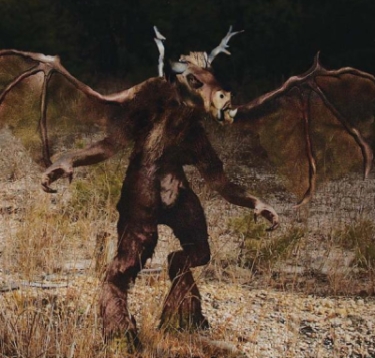
A truly hideous monster, the Jersey Devil has a lithe but powerful body that is covered in black fur, cloven hooves, and a thin neck. Atop its neck is a hideous head combining the worst features of a horse, goat, and dog. It's eyes are burning red, and they glow in the dark.

Like a horse, the Devil has large, round nostrils, while two goatlike horns shoot from the creature’s forehead, just above its twitching ears. Within the black maw that is the Jersey Devil’s mouth are extremely sharp fangs and teeth, and from its black gums and curled lips, it drools like a dog. It has two relatively short but powerful forelimbs, tipped with sharp claws that rend flesh on the slightest brush. It has two leathery, batlike wings that span approximately two feet. As it flies through the night sky, its body is sheathed in an eerie yellow aura. It also has a mournful, terrifying cry.

Abilities

A supernatural demon, the Jersey Devil possesses supernatural strength, speed, and aerial agility. It is seemingly invulnerable to harm, withstanding even a cannonball through its body with no apparent effects. The Jersey Devil is able to fly, and its wings are deadly weapons, as the creature has been seen using its wings to cut through the trunks of trees with ease. The Jersey Devil is able to become invisible at will, allowing it access to even the most heavily guarded homes or livestock. Its fetid breath can curdle milk, and has been known to kill the entire fish population in a lake with only a single breath. Along with its rank breath, the Jersey Devil is able to breathe fire, using it to injure or blind attackers or potential prey. The Devil is constantly surrounded by an evil aura that causes bad fortune to befall all witnesses.

It may have other supernatural powers that it may yet have to display. To debate, some people believe that the Jersey Devil may or may not have supernatural powers, but it is highly likely that they are wrong.

Weaknesses

Since the Jersey Devil is seems to be immune to most weapons, it is nearly impossible to destroy the Devil. However, it may in fact be weak against holy symbols, such as a crucifix or the Bible. Traveling with a bright lantern may be a good idea, since light might dissuade the Devil from attacking.

History

If one knows anything about the Pine Barrens, he might know about its demonic resident. Deep in the heart of South Jersey lies a huge span of dark, desolate woods. These trees give off an eerie feeling- as if one is constantly being watched. The plants are so dense it is often times hard to follow a path, and one never knows what kind of wildlife is concealed in the brush. You have no idea where they are, but they know exactly where you are... Herein lurks the Jersey Devil.

The legend of the Jersey Devil has existed for over 265 years, since before the birth of our country. It has terrorized, puzzled, and intrigued New Jersey's population since the 1700's. It is a mystery that has been passed down from generation to generation and still remains unsolved. Two centuries after the legend's origin, we still only have myths, theories, and horrifying recounts of sightings.

So what is the legend? The story begins in 1735 when a Mrs. Leeds of Smithville was pregnant. This was to be her thirteenth child, and Mrs. Leeds was feeling old before her time. As her labor began one stormy night, she cursed the unborn baby during a fit of painful contractions, saying, "Let this child be a devil!" Mrs. Leeds soon forgot her curse when the midwife placed a beautiful baby boy in her arms. Suddenly the baby's body started to mutate, and Mrs. Leeds watched in horror as the baby's face elongated to resemble a bat or horse, and long, dark wings sprouted from his shoulder blades. His legs grew long and thin and his pudgy feet hardened and formed into hoof-like extremities. Fear gripped all in the room as long claws grew from the baby's fingertips and his blue eyes yellowed. The creature before them now showed no resemblance to the baby it had been just moments before its transformation. The cry of an infant in the next room caught the creature’s attention. Rushing to the room, it scooped its baby brother out of his crib, opened its mouth impossibly wide, and swallowed the infant whole. The beast then proceeded to slaughter and devour its remaining brothers and sisters, as well as the midwife. Looking back on its mother, the beast let out an ear-piercing scream and then turned, burst through the roof of the cabin and flew off into the night.

That is the most common and widely accepted version of the legend, however there are several variations to the story. Let's start with the name Leeds. There are two names of the Jersey Devil's mother- Mrs. Leeds and Mrs. Shrouds. Carrie Bowen, a local of Leeds Point, once asserted that the name was Shrouds, and the actual house that the creature was born in was the Shrouds house. According to Atlantic County historian Alfred Heston, both names are possible.
Heston's research showed that both a Daniel Leeds and a Samuel Shrouds lived in Leeds Point around the time of the legend. Heston also discovered that Shrouds had lived directly across the river from the Leeds house. This fact adds to another variation- perhaps the Jersey Devil had been an illegitimate child who was cursed by the townspeople before birth.

The father of the Jersey Devil has always been a disputable topic. Some do not believe that either Mr. Leeds or Mr. Shrouds was the actual father. In fact, they do not believe the Jersey Devil has a human father; they believe the creature to be a product of Satan himself, mixed with human flesh to give it a body.

Another variation of the story of the Jersey Devil's creator is that it was the direct result of a curse from a gypsy. This variation states that Mrs. Leeds/Shrouds had denied food to a starving gypsy, who then placed a curse on the pregnant woman. Still another variation says that Mrs. Leeds/Shrouds could have been involved in witchcraft (there are even reports of a witch trial held around this time period in Mt. Holly, NJ). It is also believed that locals could have cursed the Jersey Devil’s mother because she fell in love with a British soldier, and because of the time period (before revolutionary war) was shunned.

There are also several variations on the events of the Jersey Devil's birth. Some say that the creature was born as a devil and never resembled a human. Other variations also say that before the Jersey Devil flew off into the Pine Barrens, it killed and ate all people present in the cabin. It has also been said that (assuming it did not kill all in the room) the Jersey Devil would return to its home for years and sit perched on a fence. After a while, Mrs. Leeds/Shrouds, not knowing what to do with her deformed child, "shooed" it away, and it never returned.

The other variations of the legend involve the date and location of the birth. Instead of 1735, it has been dated as 1778, 1850, 1855, 1857, 1859, 1873, and 1880 (setting it later in time would disqualify several sightings so 1735 is most widely accepted). The birthplace also differs. Besides the commonly accepted Leeds Point, it has been placed in Estellville, Pleasantville, and Burlington. Leeds Point has remained the most popular birthplace due to the fact that it has a physical supposed birth house out in the middle of the woods.

It is believed that the Jersey Devil may have had a name. Smith J. Leeds is the supposed name of the baby that became the beast. While on an excursion to Leeds Point, I found a gravesite with the name of Smith J. Leeds, belonging to someone who had died within two years of birth. The rumor of the name has never been proven.

Regardless of which legend is believed, all versions have a common result- a winged creature set free to roam the Pine Barrens for the rest of its lifetime. Immediately, the creature decided to do what every baby does, regardless of its species- it decided to explore its surroundings and make itself known.

The Jersey Devil began to roam New Jersey boldly as soon as it was born. Immediately, the Pine Barrens were explored and the residents were terrified. They could not believe their eyes as an unknown winged serpent appeared all around the Pine Barrens, seemingly unaffected by human presence.

The first five years after its birth were so horrific that in 1740 a bold clergyman decided to exorcise the Jersey Devil, banning it from the humans. The people of the Pine Barrens received instant relief as the sightings suddenly ceased. The legend lived on, and was passed down from each generation with a warning that the exorcism would only last for 100 years, and that those who live in the Pine Barrens in the 1840’s should be prepared for the creature’s return.

During the exorcism period, only two sightings were recorded. These two sightings do not contradict the exorcism - it was humans who encountered the beast in the woods, not the beast that found them. In both cases, no harm befell any humans or their possessions.

Both sightings came from highly reputed figures during that time period. The first, which occurred sometime between 1800 and 1820, involved naval hero Commodore Stephan Decatur. Decatur was visiting Hanover Iron Works, where he was testing cannonballs to ensure high quality. One day, while out in the Pine Barrens, Decatur noticed a strange creature flying overhead. He immediately fired a cannonball through the beast, and was shocked when the creature continued flying, completely unaffected by the gigantic hole the cannonball had created through its wing. The second sighting was made by the former King of Spain and brother of Napoleon, Joseph Bonaparte. Joseph Bonaparte resided in Bordentown and believed to have seen the Jersey Devil while hunting between 1816 and 1839.

In both cases, the Jersey Devil did not seek out any human contact. It was merely observed while existing peacefully in the Pine Barrens. The people of New Jersey experienced no strange losses of livestock, and all seemed peaceful and calm during the Jersey Devil’s exorcism. This would all change. In 1840, the Jersey Devil reappeared with a vengeance, right on schedule. The Jersey Devil’s first act was a raid on livestock, and as a result many people lost a large amount of sheep and chickens. 1841 was a continuation of this raid, but this time the Jersey Devil left more evidence - during its livestock theft it screamed chillingly and left unidentifiable tracks. All attempts to locate this creature were unsuccessful.

The return of the Jersey Devil brought panic along, and the residents of the Pine Barrens were once again gripped with fear, just as their ancestors had been 100 years before. In 1858, W.F. Mayer of New York was visiting Hanover Iron Works (the sight where Decatur had seen the creature) and noticed how odd the Pine Barrens residents acted. They seemed constantly nervous and uneasy. When Mayer commented on a storm, one resident mentioned something about seeing a Devil, and was hushed by other residents, fearing that the Devil could be listening. Mayer also noticed that no resident of the Pine Barrens would ever dare to venture outside after dark.

In 1859 the Jersey Devil was seen in Haddonfield, and then remained unseen until the winter of 1873 - 1874, where it was seen periodically in Bridgeton and Long Branch. The creature continued to raid livestock and was believed to "carry off anything that moved". In 1894 the Jersey Devil made appearances throughout New Jersey, visiting Smithville, Long Beach Island, Brigantine Beach, Leeds Point, and Haddonfield.

In 1899 the Jersey Devil raided Vincentown and Burrsville, and then decided to expand its horizons and head for New York. The creature made its first out-of-state appearance in Spring Valley, New York, where a resident was repeatedly losing sheep and hearing "ungodly" screams. At one point, the resident spotted the thief, and described it as a "flying serpent". This resident’s report would be the first Jersey Devil sighting ever to be published in the newspapers.

The creature remained in New York for a brief period, where it was sighted at Hyenga Lake (rumors had it that a strange creature that could fly, swim, and run became a frequent visitor). Eventually, the Jersey Devil decided to return to its home state, but not without leaving strange tracks in New York’s marshes.

By the turn of the century, the Jersey Devil’s existence became a common belief in New Jersey and its bordering states. The people believed that an eerie, supernatural creature lived in the Pine Barrens. The people also believed that the sightings and tales would soon die out, and that the legend of the Jersey Devil had run its course. Soon they would realize that they were sadly mistaken.

The 1900's started off with a major bang for the Jersey Devil legend. In 1909, the largest batch of Jersey Devil sightings ever recorded occurred, in which the Jersey Devil was seen by over 100 people in the time span of a single week. This week, January 16th through January 23rd, has been justly named Phenomenal Week. During this time, a wide range of people throughout the Delaware Valley spotted the winged beast. Some sightings were seen by large groups of people at once; other sightings were made by residents who were awakened in the middle of the night to strange noises in the darkness.

The huge amount of sightings caused New Jersey to enter State of Emergency precautions, with all residents instructed to be in their homes before dark and to secure all animals at night. Newspapers were filled with detailed sighting accounts, although many articles seemed mocking in tone. The people of the area were terrified - especially those living deep in the heart of the Pine Barrens.

The Jersey Devil became New Jersey's Official Demon in the 1930's, recognizing the history of the legend and its importance in New Jersey history. This creature is also the namesake of the state's hockey team, the New Jersey Devils.

During the early 1900's, however, the legend was scarred by the marks of scam artists attempting to make money off of the people's fear. One man in particular went to extremes to create a very elaborate hoax. This man obtained a wild kangaroo, painted stripes on its fur, attached "wings" to its shoulder blades, and kept the creature in a dimly lit cage, charging all curious visitors a fee to take a peek at what he claimed to be the Jersey Devil. When the visitors approached the cage, a man sitting behind the kangaroo (armed with a long stick with a nail in one end) would smack at the creature, causing it to lunge forward and shriek in pain - frightening all who saw. Eventually, the man came clean on his hoax, and since then the Jersey Devil has not been taken as seriously as it had been before.

At one point, the charred remains of a strange creature were found somewhere in the Pine Barrens. These remains were unidentifiable by the Department of Wildlife and Conservation - they had no record of any such creature on file. Some believed these remains were those of the Jersey Devil, and thought the legend was finally put to an end. But once again, the Jersey Devil returned.

In 1951 - 1952, the Jersey Devil came back to New Jersey for the Gibbstown - Paulsboro invasion. This invasion, though on a smaller scale than Phenomenal Week, caused quite a stir in the area and sent many people into a panicked state. Posses were formed, who attempted to track the creature. Yet still no dog would follow its trail, and instead they whimpered and turned away. Because the legend was no longer taken seriously, mass hysteria was blamed for the cause of the uprise. Around this same time, newspapers started refusing any sightings accounts, believing that they were just attempts at gaining recognition and attention. The Jersey Devil legend was beginning to die. Sightings still continued to trickle in, and have remained steady throughout many years. Sightings as recent as this year have been reported. None of the above theories can give a definitive answer to what the Jersey Devil was or is, but the sightings prove there is something out there. The people of New Jersey have definitely seen something out there lurking in the Pine Barrens, and it hungers once again for the taste of flesh and fear…

Sources

The Field Guide to North American Monsters: Everything You Need To Know About Encountering Over 100 Terrifying Creatures In The Wild (W. Haden Blackman), pages 83-87 for most of the above information.

Thanks go to Laura K. Leuter for graciously giving me permission to borrow the Legend for the History part from her Devil Hunters website. This is HER work, and it should not be used without her permission. The rest of this research belongs to me.

You may find an excellent article on the Jersey Devil here: The Jersey Devil, by Dr. Bob Curran

Monday, June 20, 2011

Abiku

The Abiku is a West African demon that tempts children away from home so that it may devour them.

The Abiku has no stomach and eats constantly, but it will never know true satisfaction. It is able to dissolve itself into a cloud of smoke, and the demon uses this ability to gain entry into houses in order to feed on newborns.

Some legends seem to indicate that the Abiku is a vampiric spirit that feeds on the lifeforce of living brings (whether that be humans or animals), which usually kills the victim. The Abiku may be banished or repelled by iron, salt, amulets (forged of iron, copper, or silver), or greater spirits.

Pisacha

The Pisacha (literally "eater of raw flesh") is a ghoulish demon from Hindu mythology. These spirits are known to haunt cremation grounds, and in addition to possessing the power of shapeshifting at will and the ability to become invisible, the Pisacha are able to possess humans and drive them into insanity.

These demons are voracious flesh-eating ghouls that are caught in a limbo between Heaven and Hell, unable to redeem themselves for the terrible sins that they committed during their life. The Pisacha can be killed with a blessed sword (by either decapitation or thrusting the sword through the ghoul's heart), but it is said that their spirits will haunt the area forever, unless their presence is dispelled by certain, unspecified means (possibly a complicated ritual).

Saturday, June 18, 2011

Lilith - The Demon Queen


The Queen of Demons and Vampires, Lilith originated from the Hebrew Bible. However, the initial concept of such a demon goes much, much further back to an Assyrian demon known as Lilitu. This demoness is sexually insatiable, prowling the night in search of men to seduce and corrupt. According to the Hebrew creation story, Lilith was Adam's first wife, created from the same dust to be his equal. But they found that they soon had problems, to say the least. Lilith refused to submit to Adam, wanting to be in the dominant position (in other words, on top) while they made love. Adam refused to allow this, so Lilith fled and hid herself in a cave by the Red Sea. There, she engaged in intercourse with demons, giving birth to one hundred demons a day. These demons are known as the Lilin. At Adam's request, God sent three angels to bring her back, and not only did Lilith refuse, but she cursed at them. The angels warned her that they would slay one hundred of her unholy offspring each day if she didn't cooperate. In retaliation, Lilith vowed that not only would she never again resume a domestic lifestyle, but would henceforth drink the blood of newborn children and copulate with men whilst they slept. She did agree, however, that she would spare the life of any infant that had the names of the three angels (Sanvi, Sansanvi, and Semangelef) written where she could see them (this could be inscribed on a wall or engraved into an amulet).

It is said that parents may also protect their children by inscribing the words "Adam and Eve, barring Lilith" within a charcoal circle, drawn on a wall. There are two biblical verses that refer to Lilith. One may be found in the Book of Isaiah, who speaks of "the night hag," who dwells in the wild with the beasts. In Psalms 91:5, God promises to protect His children from "the terror by night."

It is believed that Lilith is almost as old as Satan himself, and that she cannot be slain by mere human hands alone. However, there are ways to ward off and banish the demoness. A circle of pure sea salt (or any salt that does not contain any impurities) will keep her at bay, as will pure iron that has been hammered cold, without the use of a forge or heat (such an object might inflict some degree of harm on Lilith).

According to an ancient Aramaic text (Aramaic being the language that was spoken by Jesus Christ), when a writ of divorce is served on her and she is commanded to go forth stripped, her power is taken from her. Forcing Lilith to stand in front of a mirror will deprive her of the illusion that disguises her. Her hideous true form will be revealed, and the demoness will be forced to flee. As mentioned in passing previously, an amulet that is inscribed with the names of the three angels (Sanvi, Sansanvi, and Semangelef) will protect an individual from her attentions. The names should be inscribed in Hebrew for maximum effectiveness. It is said that this method has yet to fail. Either way, beware of this whore of the night.

Sources

Illes, Judika. Encyclopedia of Spirits: The Ultimate Guide to the Magic of Fairies, Genies, Demons, Ghosts, Gods & Goddesses. New York: HarperCollins Publishers. Copyright ©2009 by Judika Illes.